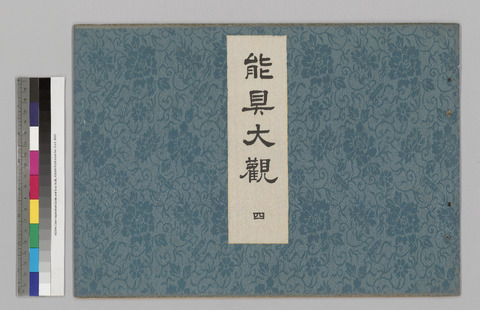
Series Cover, Vol. 4
Date: 1924
Series: [List of Noh Play Equipment)] Nôgu Taikan (能具大鑑)
Image courtesy of the University of Pittsburgh
YAMAGUCHI RYÔSHÛ
(山口蓼洲)
1924 (Nôgu Taikan
Vol. 4)
Series Cover, Vol. 4
Date: 1924
Series: [List of Noh Play Equipment)] Nôgu Taikan (能具大鑑)
Image courtesy of the University of Pittsburgh
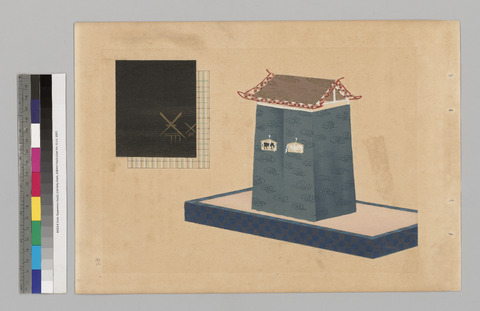
Play: Ema (繪馬)
Print Date: 1924
Series: [List of Noh Play Equipment)] Nôgu Taikan (能具大鑑) #78
Image courtesy of the University of Pittsburgh
Note: Tsukurimono: Yashirodai placed on an ichijôdai. In maeba
(the first half act), it represents a
palace and wooden votive tablets of white and black horses are
hanged up. In nochiba (the second
half act), it represents the ama-no-iwato, a cave behind a massive
rock door. Shikishi: Depicts the
Saikû Shrine at Ise and the pattern of small grid for Mae-shite's
kitsuke (short-sleeved kimono).
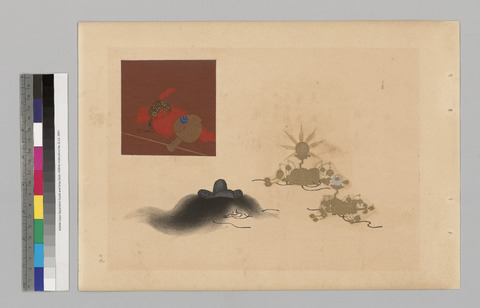
Play: Ema (繪馬)
Print Date: 1924
Series: [List of Noh Play Equipment)] Nôgu Taikan (能具大鑑) #79
Image courtesy of the University of Pittsburgh
Note: Hi-tengan: Tengan with a headdress representing the sun.
Headdress is not used by all schools.
Tsuki-tengan: Tengan with a headdress representing the moon.
Suki-kanmuri: Black crown with kurotare
(black wig). Shikishi: Depicts an oni-zukin (hood for a
devil/demon) and kanazuchi (hammer) for Kyôgen-
kata.
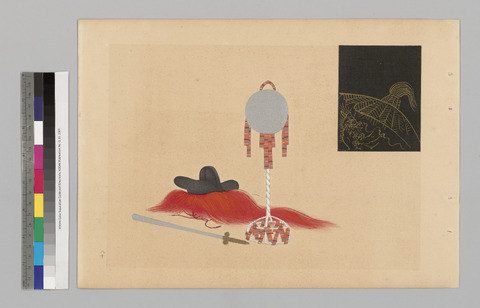
Play: Kôtei (皇帝)
Print Date: 1924
Series: [List of Noh Play Equipment)] Nôgu Taikan (能具大鑑) #80
Image courtesy of the University of Pittsburgh
Note: Tsukurimono: Mirror. This is in accordance with Kanze
school's style. Tōkanmuri (black crown
for demon god) with akagashira (red wig) for Nochi-shite. Katana
(sword) for Nochi-shite. Shikishi:
Depicts the ghost of Shôki exorcising the devil/demon.
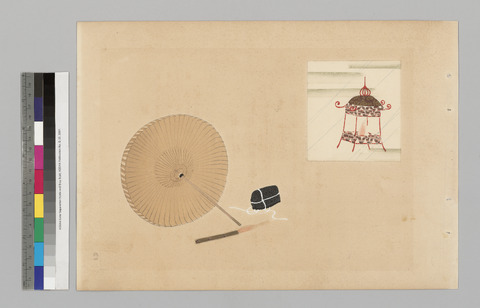
Play: Aridôshi (蟻通)
Print Date: 1924
Series: [List of Noh Play Equipment)] Nôgu Taikan (能具大鑑) #81
Image courtesy of the University of Pittsburgh
Note: Kasa: Umbrella. Used only for the play "Aridôshi."
Okina-eboshi: Hat worn by okina. Takimatsu:
Torch. Shikishi: Depicts tôrô (lantern). No longer used. It says
in the play, "At night in Shôshô, it rains
incessantly..."
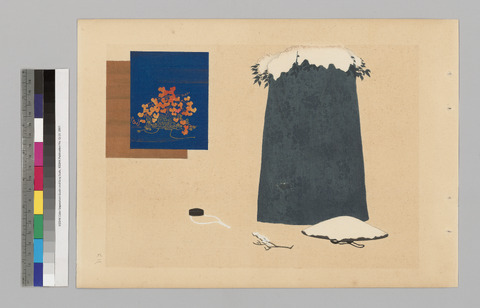
Play: Kazuraki (葛城)
Print Date: 1924
Series: [List of Noh Play Equipment)] Nôgu Taikan (能具大鑑) #82
Image courtesy of the University of Pittsburgh
Note: Tsukurimono: Mochinoki (a mochi tree) with cotton on the
top. Mochi eda: Branch of a mochi tree
without leaves and with cotton on it. Kasa: Cotton-covered hat.
Zukin: Hood for yamabushi priest.
Shikishi: depicts the tengan with a headdress of kudzu for
Nochi-shite. Used only when "Yamato-mai"
kogaki is performed.
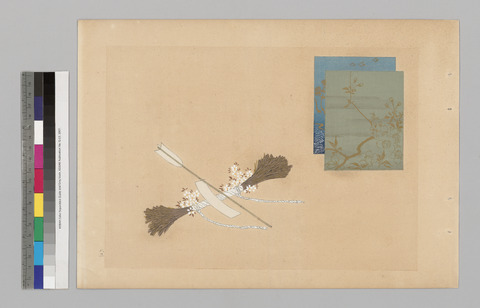
Play: Tadanori (忠度)
Print Date: 1924
Series: [List of Noh Play Equipment)] Nôgu Taikan (能具大鑑) #83
Image courtesy of the University of Pittsburgh
Note: Oishiba: Firewood that Mae-shite carries on his back. Some
schools attach a sprig of cherry
blossoms. Ya: Arrow with tanzaku (poem strip). Shikishi: Depicts a
scene of the Suma Bay and young
cherry blossom tree.
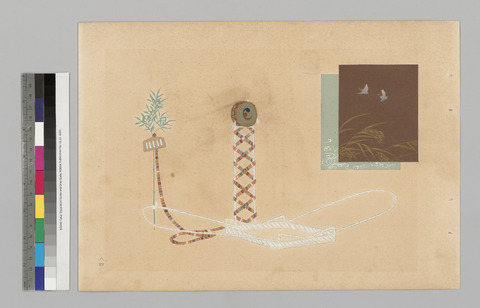
Play: Torioibune (鳥追船)
Print Date: 1924
Series: [List of Noh Play Equipment)] Nôgu Taikan (能具大鑑) #84
Image courtesy of the University of Pittsburgh
Note: Tsukurimono: Fune (boat) with kakko (small tabor), naruko
(bird clapper), and sasa (shaft of
bamboo grass.) Slight differences depending on school. Shikishi:
It says in the play, "It is interesting
that they were just rice seedlings yesterday but, while I am
unaware, they are now rice ears in the
autumn breeze... "
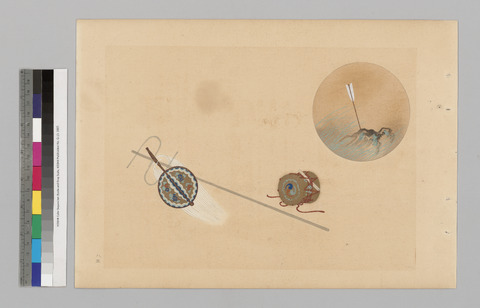
Play: Hôkazô (放下僧)
Print Date: 1924
Series: [List of Noh Play Equipment)] Nôgu Taikan (能具大鑑) #85
Image courtesy of the University of Pittsburgh
Note: Tsukurimono: Bamboo stick with a white wig and a Chinese
fan. Kakko (small tabor) for Nochi-
shite. Circle on the top right: It says in the play, "He has seen
a shaped like a tiger and he thought that
was his enemy. Having an arrow on his bow-string, he shot with all
his might..."
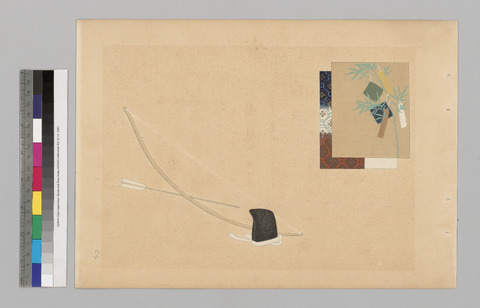
Play: Hôkazô (放下僧)
Print Date: 1924
Series: [List of Noh Play Equipment)] Nôgu Taikan (能具大鑑) #86
Image courtesy of the University of Pittsburgh
Note: Kanze school. Nashiuchi-eboshi (type of hood) with shiro
hachimaki (white head band) for
Tsure. Yumiya (bow and arrow). Shikishi: Front shikishi depicts a
stick of bamboo grass with color
paper strips. Worn by Tsure on his waist. Kongō school does not
use it. Back shikishi depicts the
pattern of atsuita, a type of short-sleeved kimono for Tsure.
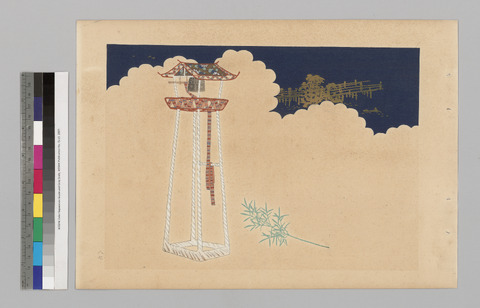
Play: Miidera (三井寺)
Print Date: 1924
Series: [List of Noh Play Equipment)] Nôgu Taikan (能具大鑑) #87
Image courtesy of the University of Pittsburgh
Note: Tsukurimono: Shôrô (bell tower). Differs slightly depending
on school. Mochimono: Sasa
(shaft of bamboo grass) for Shite, the mad woman. Unkei:
cloud-shaped background depicts
the Seta-no-Karahashi Bridge near the Lake Biwa.
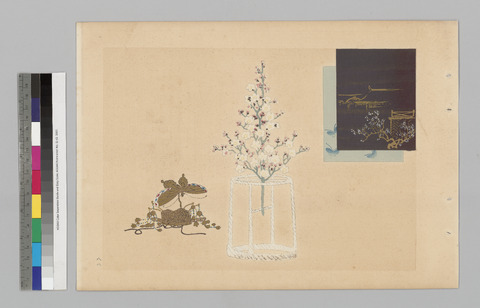
Play: Kochô (胡蝶)
Print Date: 1924
Series: [List of Noh Play Equipment)] Nôgu Taikan (能具大鑑) #88
Image courtesy of the University of Pittsburgh
Note: Kanze school. Tsukurimono: Marudai (round frame) supporting
an artificial plum tree. Kanmuri:
Crown with a headdress of a butterfly. Shikishi: Depicts the scene
of plum trees blooming at miyako
ômiya-zukuri (a shrine building in Kyoto).
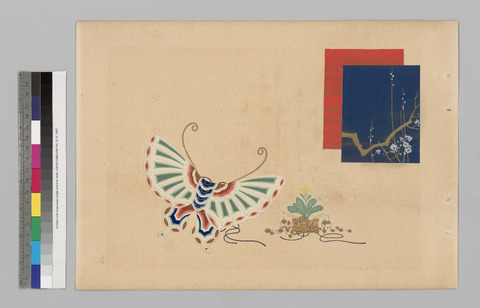
Play: Kochô (胡蝶)
Print Date: 1924
Series: [List of Noh Play Equipment)] Nôgu Taikan (能具大鑑) #89
Image courtesy of the University of Pittsburgh
Note: Kongô school. Tsukurimono is the same as in Kochō 1. In
Kongô school, an ornament of
butterfly like the one depicted in the print is attached to the
shoulder of Nochi-shite. Kanmuri: Crown
with a headdress of natane (rape blossom). Shikishi: Depicts plum
blossoms.
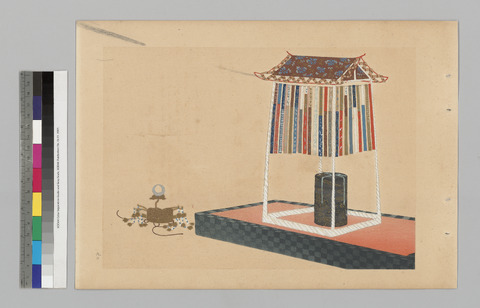
Play: Yôkihi (楊貴妃)
Print Date: 1924
Series: [List of Noh Play Equipment)] Nôgu Taikan (能具大鑑) #90
Image courtesy of the University of Pittsburgh
Note: Kongô School. Tsukurimono: Wooden frame with a roof made of
cloth decoration. Kazuraobi
(band for a wig) are hanging around from the upper side. Used only
when "Tamasudare" kogaki is
performed. Ichijôdai: Kazuraoke (cylindrical lacquered container)
is placed on it. Ô-kanmuri: Crown
with a headdress representing the moon for Shite.
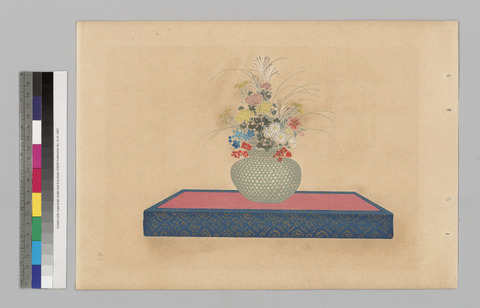
Play: Hajitomi (半蔀)
Print Date: 1924
Series: [List of Noh Play Equipment)] Nôgu Taikan (能具大鑑) #91
Image courtesy of the University of Pittsburgh
Note: Kongô school. Tsukurimono: Flower basket on an
ichijōdai. This tsukurimono is used only
when "Rikka kuyô" (a memorial service for flowers and trees)
kogaki is performed. A large pine tree
is used depending on the school.
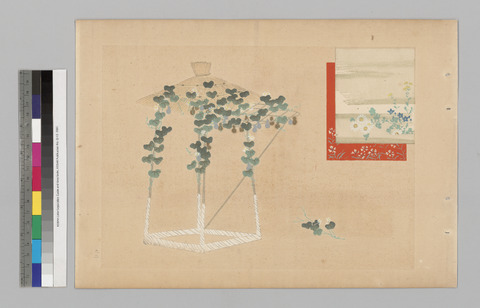
Play: Hajitomi (半蔀)
Print Date: 1924
Series: [List of Noh Play Equipment)] Nôgu Taikan (能具大鑑) #92
Image courtesy of the University of Pittsburgh
Note: Kongô school. Tsukurimono: Hajitomi: Thatched hut with
hinged half wall. Bines of gold and
silver colored hisago (gourds) are entangled in it. Shikishi: It
says in the play, "Visit me, please, for
the lovely maiden pink. If you show me your past figure as
beautiful as the flower..."
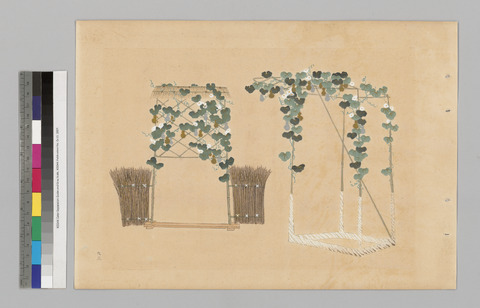
Play: Hajitomi (半蔀)
Print Date: 1924
Series: [List of Noh Play Equipment)] Nôgu Taikan (能具大鑑) #93
Image courtesy of the University of Pittsburgh
Note: Kanze school. Tsukurimono: Shibagaki (bush clovers hedges),
depicted on left of the print,
used only when "Rikka kuyō (a memorial service for flowers and
trees)" kogaki is performed.
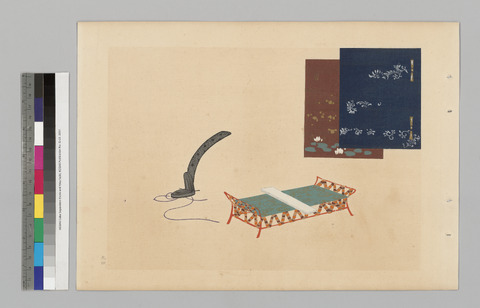
Play: Sôshiarai Komachi (草紙洗小町)
Print Date: 1924
Series: [List of Noh Play Equipment)] Nôgu Taikan (能具大鑑) #94
Image courtesy of the University of Pittsburgh
Note: Tsukurimono: Bundai (small low desk) with a tanzaku (poem
strip) on it. Kanmuri: Crown with
ryûei (upright tail hanging in an arc behind a crown) for
Kokata. Shikishi: Depicts a volume of the
Man'yōshū, and uki-kusa (floating grass) which is the subject for
a poetry-writing contest.
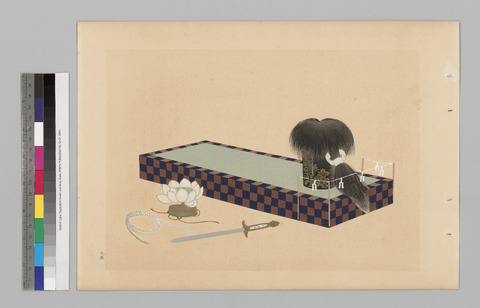
Play: Chôbuku Soga (調伏曾我)
Print Date: 1924
Series: [List of Noh Play Equipment)] Nôgu Taikan (能具大鑑) #95
Image courtesy of the University of Pittsburgh
Note: Kongô school. Tsukurimono: Kazuraoke (cylindrical lacquered
container) with kurogashira
(black wig) set on the ichijôdai. Set up shide (zigzag-shaped
paper streamers) on the ichijôdai as
shown in the print. Kanmuri: Headdress representing lotus flower
for Nochi-shite, Fudō Myôô.
Tsurugi (sword) and tenawa (rope).
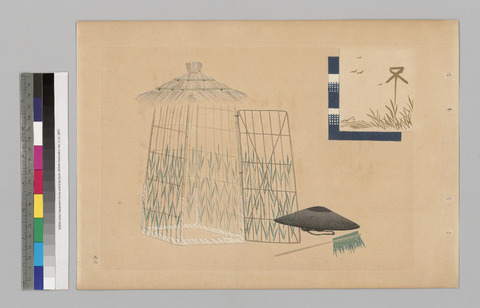
Play: Ashikari (芦刈)
Print Date: 1924
Series: [List of Noh Play Equipment)] Nôgu Taikan (能具大鑑) #96
Image courtesy of the University of Pittsburgh
Note: Tsukurimono: Thatched hut made of artificial young reeds.
Mochimono: Reeds are inserted in
the tip of wari-basami (bamboo which the tip is split).
Otoko-gasa: Men's sedge hat. Shikishi: Depicts
the scenery of Naniwa Bay and the pattern of dan-noshime, a
short-sleeved kimono with horizontal
stripes, worn by Shite.
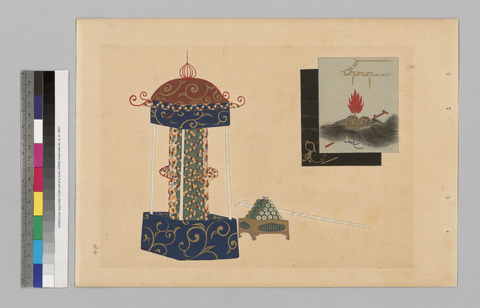
Play: Rinzô (輪蔵)
Print Date: 1924
Series: [List of Noh Play Equipment)] Nôgu Taikan (能具大鑑) #97
Image courtesy of the University of Pittsburgh
Note: Rinbutsu: Rinzô (revolving sutra stand). Frame is square
with a hexagonal roof. Inner part
rotates. Slight differences depending on the school. Kyôkan:
Scrolls of Buddhist sutra. Kasezue:
Wooden cane with a sideways grip on the top, for nochi-shite.
Shikishi: Front depicts katen-no-
kanmuri, crown with a headdress representing fire, kurogashira (a
black wig) for Tsure, and
shrine. Back shikishi depicts hitting pot by the god of Fukube
during kyôgen.
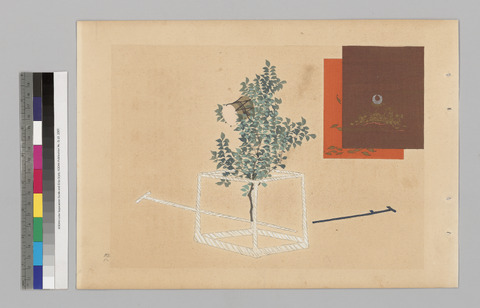
Play: Aya no Tsuzumi (綾鼓)
Print Date: 1924
Series: [List of Noh Play Equipment)] Nôgu Taikan (能具大鑑) #98
Image courtesy of the University of Pittsburgh
Note: Kongô school. Play known as "Koi no Omoni" by Kanze school.
Tsukurimono: Japanese Judas
tree supported by a square frame. Tsuzumi (Japanese hand drum) is
tied to the tree. Hôshô School
uses a large tsuzumi with white silk. Kasezue: Wooden cane with a
sideways grip on the top. Shikishi:
Depicts tengan, which is a crown for Tsure, and the fallen leaves
of Japanese Judas tree.
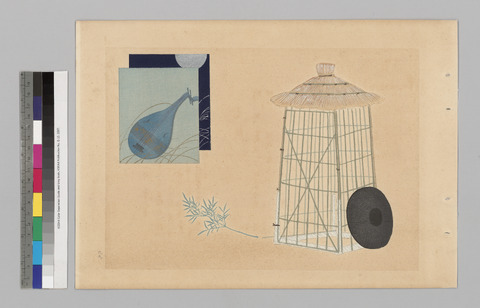
Play: Semimaru (蝉丸)
Print Date: 1924
Series: [List of Noh Play Equipment)] Nôgu Taikan (能具大鑑) #99
Image courtesy of the University of Pittsburgh
Note: Tsukurimono: Thatched roof hut with a cedar door. Kasa: Hat
for Semimaru. Tsue: Stick for
Semimaru. Sasa: Shaft of bamboo grass for Shite, Sakagami.
Shikishi: Depicts biwa (Japanese
'lute) and the moon on the edge of Mt. Ôsaka.
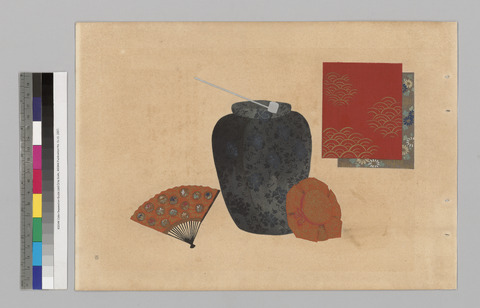
Play: Shôjô Midare (猩々乱)
Print Date: 1924
Series: [List of Noh Play Equipment)] Nôgu Taikan (能具大鑑) #100
Image courtesy of the University of Pittsburgh
Note: Tsukurimono: Tsubo (pot). Used only when "Midare" kogaki is
performed. When "Midare" dance
is performed in November, it is the last dance in the year.
Mochimono: Ōgi: Fan with the design of
summer flowers for "Midare" dance. Shikishi: Depicts the pattern
of karaori (a short-sleeved kimono)
and hangiri (a type of hakama), Shite's costume for "Midare."
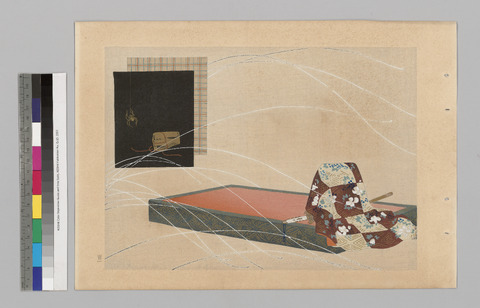
Play: Tsuchigumo (土蜘蛛)
Print Date: 1924
Series: [List of Noh Play Equipment)] Nôgu Taikan (能具大鑑) #101
Image courtesy of the University of Pittsburgh
Note: Tsukurimono: Kazuraoke (cylindrical lacquered container) is
placed on ichijôdai and covered
by haku (type of lined short-sleeved kimono). Tachi (sword) is
placed beside it. Shikishi: Depicts the
gold kazaori-eboshi for Yorimitsu and the spider. It says in the
play, "My lover will visit me tonight as
the behavior of spider tells me so..."
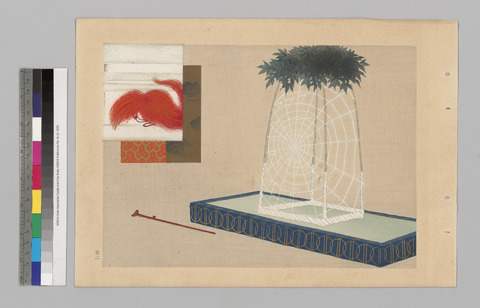
Play: Tsuchigumo (蜘蛛)
Print Date: 1924
Series: [List of Noh Play Equipment)] Nôgu Taikan (能具大鑑) #102
Image courtesy of the University of Pittsburgh
Note: Tsukurimono: Yama (mountain): Frame with mochinoki (mochi
tree) on the top. Chisuji-no-Ito
(spider's web) is put around on the frame. Ichijōdai: Kanze School
does not use this platform.
Uchizue: Thin stick. About 60 cm long, with a cross bar at the
end. Shikishi: Depicts the akagashira
(red wig) for Nochi-shite and the pattern of happi (long-sleeved
garment).
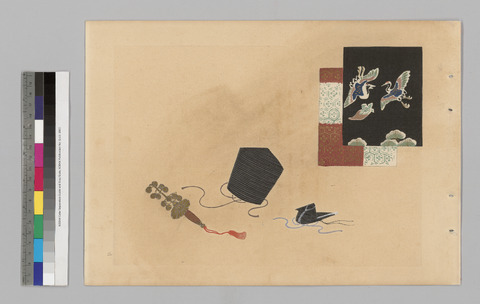
Play: Sanbasô (三番叟)
Print Date: 1924
Series: [List of Noh Play Equipment)] Nôgu Taikan (能具大鑑) #?
Image courtesy of the University of Pittsburgh
Note: This may be part of another volume. Kensaki-eboshi.
Samurai-eboshi: Worn before Senzai
and Sanbasô. Suzu (bell): Sanbasô uses this bell. Shikishi:
Depicts the patterns on kitsuke (short-
sleeved kimono) on the suô-style kimono for Sanbasô.