Series Cover, Vol. 3
Date: 1924
Series: [List of Noh Play Equipment)] Nôgu Taikan (能具大鑑)
Image courtesy of the University of Pittsburgh
YAMAGUCHI RYÔSHÛ
(山口蓼洲)
1924 (Nôgu Taikan
Vol. 3)
Series Cover, Vol. 3
Date: 1924
Series: [List of Noh Play Equipment)] Nôgu Taikan (能具大鑑)
Image courtesy of the University of Pittsburgh
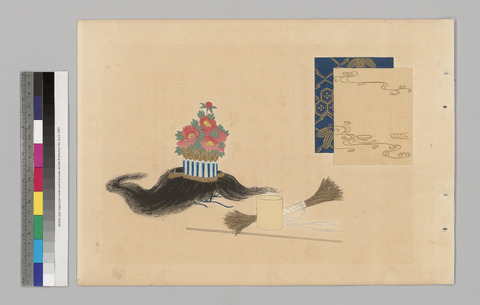
Play: Yôrô (養老)
Print Date: 1924
Series: [List of Noh Play Equipment)] Nôgu Taikan (能具大鑑) #53
Image courtesy of the University of Pittsburgh
Note: Mochimono: Bamboo stick for Mae-shite. Bucket and firewood
for Tsure. Kanmurimono: Crown
with black wig. Kanze school kogaki "Suiha no den" includes a
peony on crown. Shikishi: Front
shikishi depicts a meandering stream because it says in the play,
"...a parrot, floating on a meandering
stream, is..." Back shikishi depicts pattern on kariginu worn by
Nochi-shite.
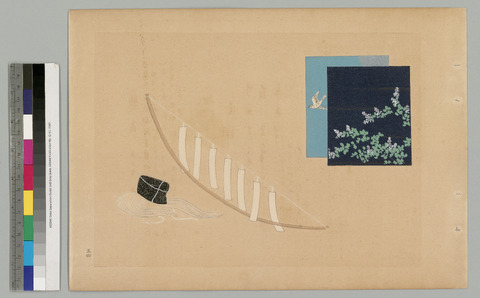
Play: Utaura (歌占)
Print Date: 1924
Series: [List of Noh Play Equipment)] Nôgu Taikan (能具大鑑) #54
Image courtesy of the University of Pittsburgh
Note: Tsukurimono: A bow and many tanzaku (long strips of paper)
tied with it. Kanmuri: An okina-
eboshi with a shirotare (white wig). Shikishi: Depicts branches
and leaves for nests and a cuckoo. It
says in the play, "Cuckoos hatch from the nest of bush warbler.
Some chicks are alike father, but some
chicks are not alike father."
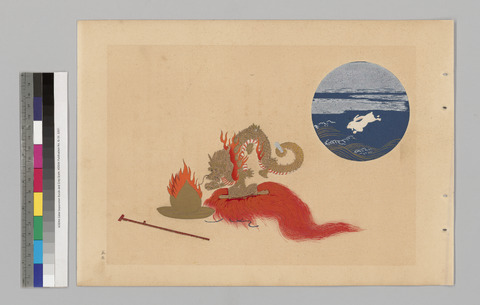
Play: Chikubushima (竹生島)
Print Date: 1924
Series: [List of Noh Play Equipment)] Nôgu Taikan (能具大鑑) #55
Image courtesy of the University of Pittsburgh
Note: Ryû-dai (crown exclusively for dragon god): Aka-gashira (red
wig) with dragon headdress for
Nochi-shite. Kinshugyoku (golden jeweled ball) for Nochi-shite.
Uchizue: Thin stick, about 60 cm long,
with cross bar at the end. Not represented in print: boat and a
pole will be used on the stage. Upper
right circle depicts the scene from poem: "Trees reflect green
shadows deeply in the lake, and fish
swimming in the lake appear to be climbing up the trees. The
rabbit on the moon jumps on the waves."
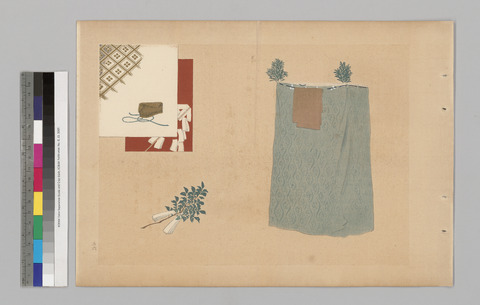
Play: Miwa (三輪)
Print Date: 1924
Series: [List of Noh Play Equipment)] Nôgu Taikan (能具大鑑) #56
Image courtesy of the University of Pittsburgh
Note: Tsukurimono: Frame simulating a cedar. The cedar is placed
in the two upper corners of the
front of the frame. Shide (zigzag-shaped paper streamers) are hung
on three sides. Cloak will be
hung on the frame during intermission, as shown on the print.
Mochimono: Nusa (strips of cut paper)
as shown on the back shikishi. Sakaki branch with shide is used in
"Hakushiki" kogaki variant, as
shown at lower left of print. Shikishi: Front shikishi depicts the
pattern of the white chōken (unlined,
long-sleeved garment) and golden Kazaori-ebôshi.
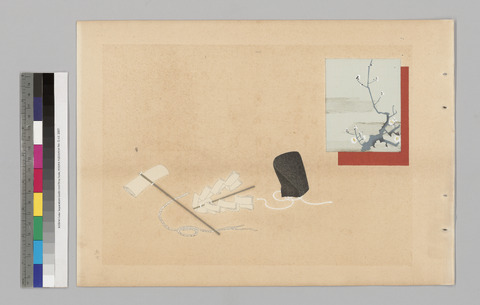
Play: Makiginu (巻絹)
Print Date: 1924
Series: [List of Noh Play Equipment)] Nôgu Taikan (能具大鑑) #57
Image courtesy of the University of Pittsburgh
Note: Mochimono: Nusa (strips of cut paper) for Shite. Makiginu:
Roll of silk tied to a stick, for Tsure.
Nawa (rope): Kyôgenkata use the rope to tie up Tsure. Tate-eboshi.
Shikishi: Depicts plum blossoms.
It says in the play, "Plum blossoms, you just open your flowers
quietly; who notices you are there
without your scent?"
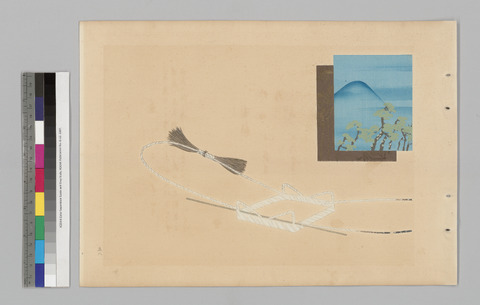
Play: Kanehira (兼平)
Print Date: 1924
Series: [List of Noh Play Equipment)] Nôgu Taikan (能具大鑑) #58
Image courtesy of the University of Pittsburgh
Note: Tsukurimono: Boat with a bundles of bush clover. Sao (pole).
Shikishi: Depicts scenery of Awazu
and Karasaki in Ômi Province.
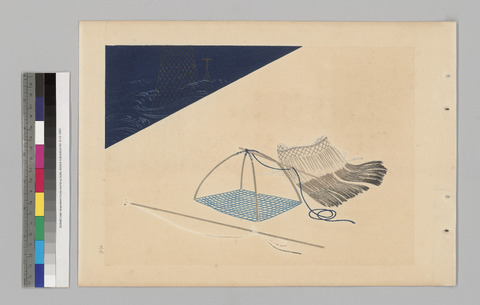
Play: Akogi (阿漕)
Print Date: 1924
Series: [List of Noh Play Equipment)] Nôgu Taikan (能具大鑑) #59
Image courtesy of the University of Pittsburgh
Note: Mochimono: Sao (pole) for Mae-shite. Ami (net) for
Nochi-shite. Koshimino (straw skirt).
Sumidokoro (upper left triangle) depicts the landscape of
Akogi-ga-ura Beach in Ise Province.
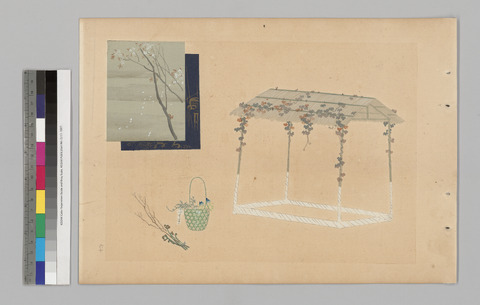
Play: Ohara Gokô (大原御幸)
Print Date: 1924
Series: [List of Noh Play Equipment)] Nôgu Taikan (能具大鑑) #60
Image courtesy of the University of Pittsburgh
Note: Tsukurimono: Ôwaraya (large, thatched hut) with kudzu vine
entwined. Mochimono: Basket
with white wisteria and summer grass. Tsumagi (firewood) with
bunches of bracken. These
mochimono may be slightly different depending on the school.
Shikishi: Front shikishi depicts late
blooming cherry blossoms. Back shikishi depicts Jakkô-in Temple in
Ôhara.
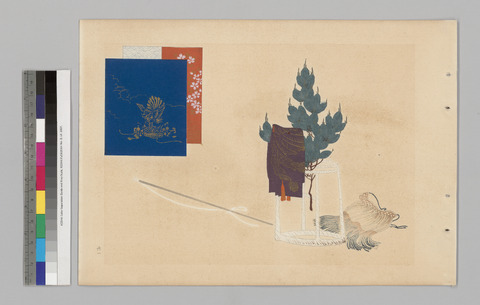
Play: Hagoromo (羽衣)
Print Date: 1924
Series: [List of Noh Play Equipment)] Nôgu Taikan (能具大鑑) #61
Image courtesy of the University of Pittsburgh
Note: Tsukurimono: Round frame and a pine tree on which robe is
hung. Pine tree may not be set on
the stage depending on the kogaki. Mochimono: Fishing rod and
koshimino (straw skirt) for Waki.
Shikishi: Front shikishi depicts tenkan, a crown worn by Shite
with phoenix headdress. Back shikishi
depicts patterns of kimono worn by Shite.
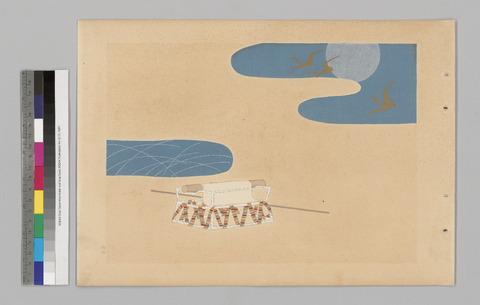
Play: Kinuta (碪)
Print Date: 1924
Series: [List of Noh Play Equipment)] Nôgu Taikan (能具大鑑) #62
Image courtesy of the University of Pittsburgh
Note: Tsukurimono: Kinuta (a fulling board for beating cloth). The
shape of this kinuta is specific to the
Hôshô school. Mochimono: Takezue, a bamboo stick for Nochi-shite.
Unsui (cloud and water): It says
in the play, "The moonlight, the wind-torn landscape, even the
frost illuminated by the light of the moon,
all blend with the sound of the kinuta when I strike the kinuta to
assuage my lonely heart."
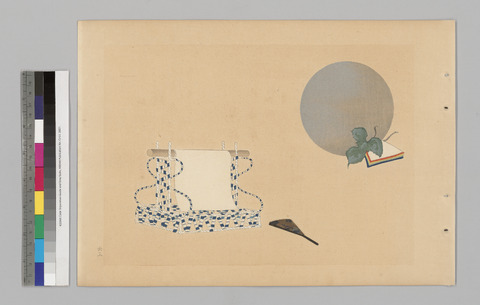
Play: Kinuta (碪)
Print Date: 1924
Series: [List of Noh Play Equipment)] Nôgu Taikan (能具大鑑) #63
Image courtesy of the University of Pittsburgh
Note: Kanze school. Tsukurimono: Kinuta (a fulling board for
beating cloth). Mochimono: Fan. Top
right circle depicts the moon. It says in the play, "The Orihime
(weaving girl) can meet her lover,
Hikoboshi (goat herd) only one night at Tanabata."
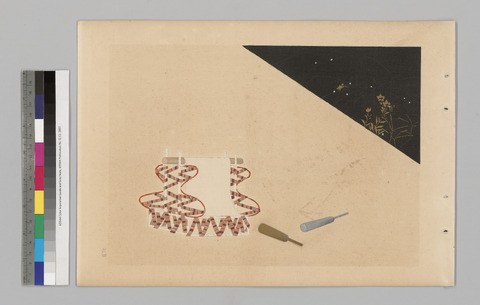
Play: Kinuta (碪)
Print Date: 1924
Series: [List of Noh Play Equipment)] Nôgu Taikan (能具大鑑) #64
Image courtesy of the University of Pittsburgh
Note: Kongô school. Tsukurimono: Unlike Kanze school, Kongô school
uses gold and silver beaters
to beat kinuta. Background depicts a rustic atmosphere in Fall.
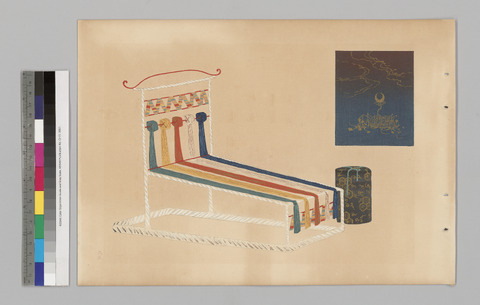
Play: Kureha (呉服)
Print Date: 1924
Series: [List of Noh Play Equipment)] Nôgu Taikan (能具大鑑) #65
Image courtesy of the University of Pittsburgh
Note: Kongō school. Tsukurimono: A weaving machine with threads
of five colors. There are slight
differences in other schools. Kazuraoke: Chair for Shite.
Shikishi: Depicts the tengan (round metal
crown with delicate decorative tassels) for Nochi-shite.
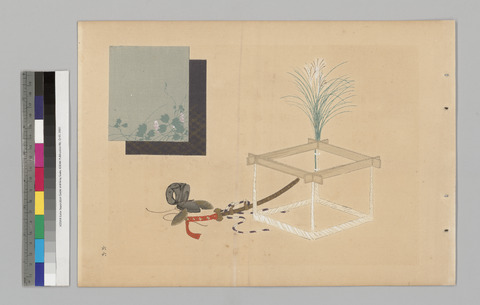
Play: Izutsu (井筒)
Print Date: 1924
Series: [List of Noh Play Equipment)] Nôgu Taikan (能具大鑑) #66
Image courtesy of the University of Pittsburgh
Note: Tsukurimono: Izutsu (well curb) with artificial or fresh
Japanese silver grass. The location of
Japanese pampas grass in Izutsu varies from school to school.
Tachi: Ma-dachi (Japanese sword)
with a kazura-obi (strap). Kanmuri: Ui-kanmuri with a rounded tail
on the back of the crown and
oikake on both sides. Same as that used in Kakitsubata. Shikishi:
Depicts autumn flowers and the
pattern of chôken (the Narihira-bishi pattern).
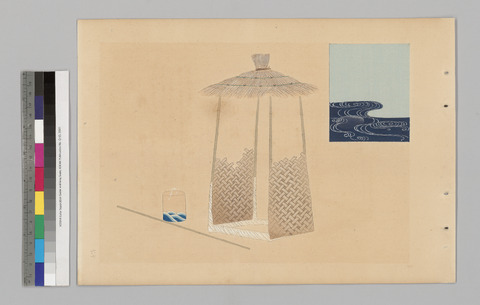
Play: Higaki (檜垣)
Print Date: 1924
Series: [List of Noh Play Equipment)] Nôgu Taikan (能具大鑑) #67
Image courtesy of the University of Pittsburgh
Note: Tsukurimono: Higaki's thatched hut. Mochimono: Mizuoke
(water bucket) and takezue (bamboo
stick). Some schools use mizuoke with no design. Shikishi: Depicts
Shirakawa river. It says in the play,
"The Shirakawa River reflects the moon light, the sleeves drawing
the water are wet by my tears as the
moon wets them..."
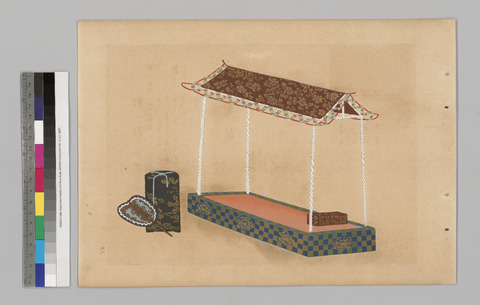
Play: Kantan (邯鄲)
Print Date: 1924
Series: [List of Noh Play Equipment)] Nôgu Taikan (能具大鑑) #68
Image courtesy of the University of Pittsburgh
Note: Tsukurimono: Tateshadai (Commonly known as Hikitateômiya
引立大宮), wooden frame with
a roof made of cloth decoration, and a pillow. Thatched roof may
be used when kogaki is performed.
Kazuraoke: Chair for Shite. Tô-uchiwa: Chinese style round fan.
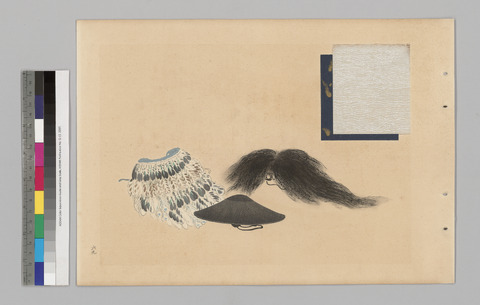
Play: Utô (善知鳥)
Print Date: 1924
Series: [List of Noh Play Equipment)] Nôgu Taikan (能具大鑑) #69
Image courtesy of the University of Pittsburgh
Note: Kurogashira: Black wig for Shite. Traditionally made of yak
hair. Otoko gasa: Man's sedge hat
for Shite. Hamino: Skirt of bird's feathers. Shikishi: Front
shikishi depicts the pattern of mizugoromo
(long-sleeved garment) for Shite. Back shikishi depicts feathers
of falcon.
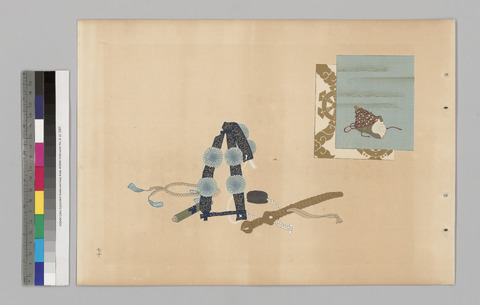
Play: Ataka (安宅)
Print Date: 1924
Series: [List of Noh Play Equipment)] Nôgu Taikan (能具大鑑) #70
Image courtesy of the University of Pittsburgh
Note: Yui-gesa: Buddhist stole for mountain priests. Zukin: Small
black hat for mountain priests.
Kogatana: Small sword. Juzu: Buddhist prayer beads. Makimono:
Kanjinchō, subscription scroll,
documenting donations for temples. Shikishi: Front shikishi
depicts horagai (trumpet shell). Kyōgen-
gata uses it when "Mitate mitsuke" kogaki is performed. Back
shikishi depicts the pattern of hangiri
(hakama) for Shite.
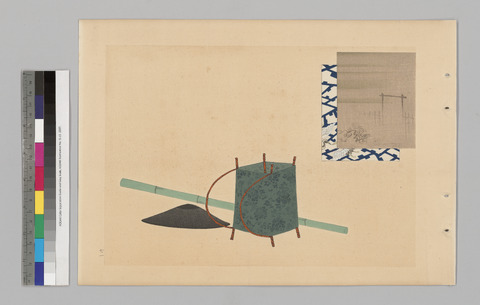
Play: Ataka (安宅)
Print Date: 1924
Series: [List of Noh Play Equipment)]Nôgu Taikan (能具大鑑) #71
Image courtesy of the University of Pittsburgh
Note: Props on this print are all for Kokata, Yoshitsune.
Tsukurimono: Oi, a box that mountain priests
carry on their back to carry items when on pilgrimage. Mochimono:
Aodake, green bamboo shaft.
Otoko gasa: Man's sedge hat. Shikishi: Front shikishi depicts the
scenery of the Ataka Barrier. Back
shikishi depicts the pattern of kimono for Waki, an official of
the Ataka Barrier.
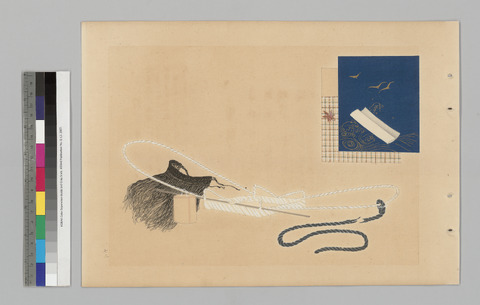
Play: Shunkan (俊寛)
Print Date: 1924
Series: [List of Noh Play Equipment)] Nôgu Taikan (能具大鑑) #72
Image courtesy of the University of Pittsburgh
Note: Fune (boat) attached to tomotsuna (mooring rope). Sao
(pole). Mochimono: Mizuoke (water
bucket). Koshimino: Grass skirt. Only Kanze school uses the
koshimino made of arame (seaweed).
Shikishi: Depicts rough waves and shamenjô (letter of amnesty). It
says in the play, "I reduced myself
to this miserable state like leaves falling off trees in the late
fall, I use such a leaf as my cup."
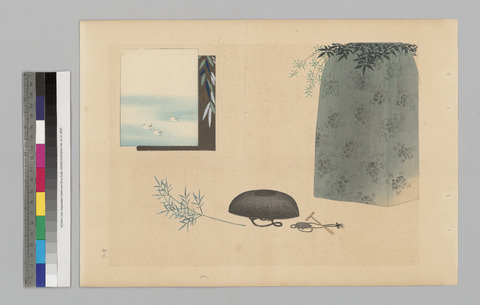
Play: Sumidagawa (隅田川)
Print Date: 1924
Series: [List of Noh Play Equipment)] Nôgu Taikan (能具大鑑) #73
Image courtesy of the University of Pittsburgh
Note: Tsukurimono: Tsuka (mound). Leaves and hanging young willows
attached from the top. Onna
gasa (women's hat) for Shite. Kane (handbell) and Shumoku (wooden
hammer) for Shite. Sasa (shaft
of bamboo grass) for Shite. Shikishi: Front shikishi depicts
miyako-dori (hooded gulls at Sumida River).
Back shikishi depicts the koshimaki pattern.
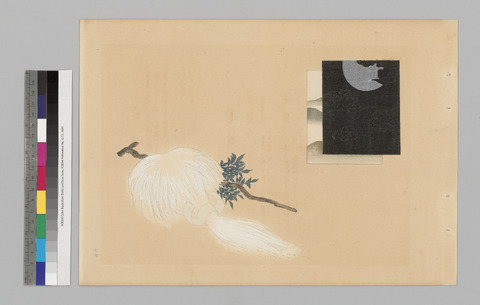
Play: Yamanba (山姥)
Print Date: 1924
Series: [List of Noh Play Equipment)] Nôgu Taikan (能具大鑑) #74
Image courtesy of the University of Pittsburgh
Note: Kanze school. Shirogashira: White wig. Kasezue: Wooden cane
with a sideways grip on the top.
Leaves are attached. When using shirogashira, natural wood is
used. Shikishi: Front shikishi depicts
the pattern of chûkei (fan) for Yamanba in Kanze school. Back
shikishi depicts the landscape of one
mountain after another.
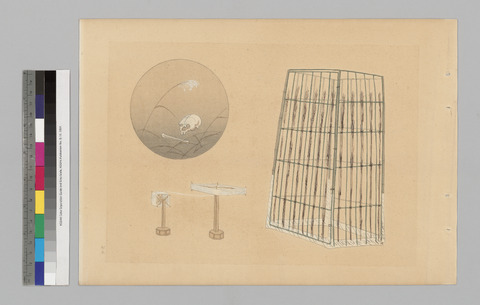
Play: Kurozuka (黒塚)
Print Date: 1924
Series: [List of Noh Play Equipment)] Nôgu Taikan (能具大鑑) #75
Image courtesy of the University of Pittsburgh
Note: Tsukurimono: Hut thatched with brushwood. Waku-kasewa:
Spinning wheel. Moon (the circle
at top left): Depicts an autumn scene with a skull. It says in the
play, "The ear of silver grass is
''growing in fall and waiting for the moon at night."
Play: Kurozuka (黒塚)
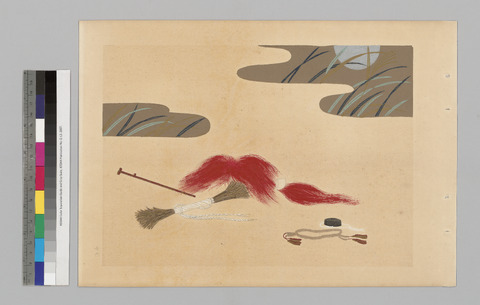
Print Date: 1924
Series: [List of Noh Play Equipment)] Nôgu Taikan (能具大鑑) #76
Image courtesy of the University of Pittsburgh
Note: Akagashira: Red wig. In Kanze school, shirogashira (white
wig) is used sometimes. Oishiba:
Firewood Nochi-shite carries on her back. Uchizue: Thin stick.
About 60 cm long, with a cross bar at
the end. Zukin: Hood. Juzu: Buddhist prayer beads. Kumotorikata:
Cloud-shaped background depicts
the koshimaki pattern.
Play: Kokaji (小鍛冶)
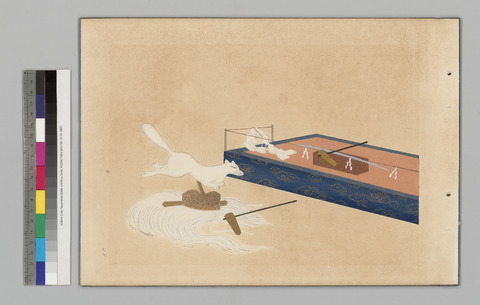
Print Date: 1924
Series: [List of Noh Play Equipment)] Nôgu Taikan (能具大鑑) #77
Image courtesy of the University of Pittsburgh
Note: Kongō school. Tsukurimono: Ichijôdai. Katana (sword),
kanatoko (anvil), and tsuchi
(hammer) are placed on the ichijôdai. Nusa and shide
(zigzag-shaped paper streamers) are
set up on the ichijôdai as shown in the print. All schools use the
same ichijôdai. Kashira
(headgear): Shirogashira kanmuri (a crown with white wig) with
white fox headdress. The
white fox is used only "Shirogashira" kogaki is performed. Golden
fox headdress is used when
there is no kogaki. In Kanze school, fox headdreass is not used
when they use a white wig.