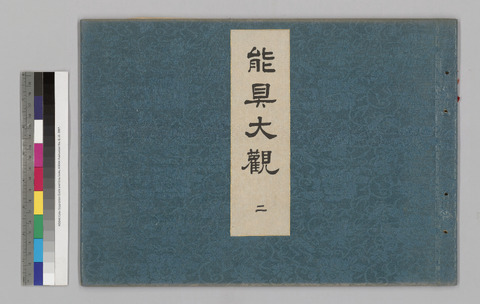
Series Cover, Vol. 2
Date: 1924
Series: [List of Noh Play Equipment)] Nôgu Taikan (能具大鑑)
Image courtesy of the University of Pittsburgh
YAMAGUCHI RYÔSHÛ
(山口蓼洲)
1924 (Nôgu Taikan
Vol. 2)
Series Cover, Vol. 2
Date: 1924
Series: [List of Noh Play Equipment)] Nôgu Taikan (能具大鑑)
Image courtesy of the University of Pittsburgh
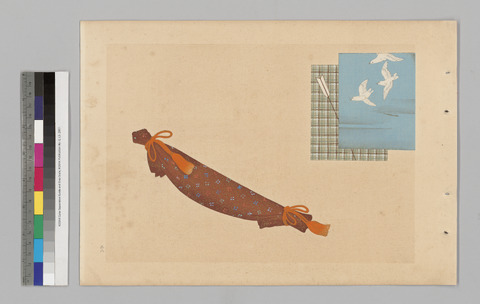
Play: Yumi Yawata (弓八幡)
Print Date: 1924
Series: [List of Noh Play Equipment)] Nôgu Taikan (能具大鑑) #28
Image courtesy of the University of Pittsburgh
Note: Tsukurimono: Bow wrapped in a red brocade bag. Shikishi:
Depicts doves, sacred to the god of
Hachiman Shrine, and the pattern of small grid for Shite's kitsuke
(short-sleeved kimono).
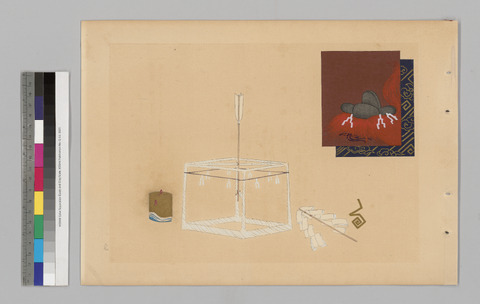
Play: Kamo (加茂)
Print Date: 1924
Series: [List of Noh Play Equipment)] Nôgu Taikan (能具大鑑) #29
Image courtesy of the University of Pittsburgh
Note: Kanze school. Tsukurimono: An arrow stands in the square
frame. Shide (zigzag-shaped paper
streamers) are hung facing the four directions. Four gold arrows
depicting lightning are tied to the
black wig when Kanze School's kogaki "Shirabataraki " is
performed. It is not depicted on the print.
Mochimono: Mizu oke (cylindrical wooden bucket) for Mae-shite and
Tsure. Nusa (strips of cut paper)
for Nochi-tsure. Shikishi: Depicts Nochi-shite's tôkanmuri (black
crown for demon god) with a red wig
and four shide, and the pattern of kariginu.
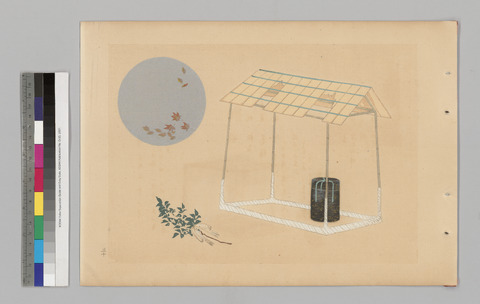
Play: Ugetsu (雨月)
Print Date: 1924
Series: [List of Noh Play Equipment)] Nôgu Taikan (能具大鑑) #30
Image courtesy of the University of Pittsburgh
Note: Tsukurimono: Itaya (shingle roofed hut). Kodôgu (small
prop): Kazura-oke (cylindrical
lacquered container). Mochimono: Sakaki branch tied with grass.
This prop is no longer used.
The upper left circle depicts the moon with maple leaves in it. It
says in the play, "The maple
leaves fall as piling, the various colors are woven."
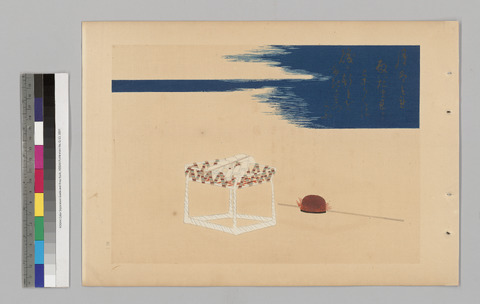
Play: Ugetsu (雨月)
Print Date: 1924
Series: [List of Noh Play Equipment)] Nôgu Taikan (能具大鑑) #31
Image courtesy of the University of Pittsburgh
Note: Tsukurimono: Nusadai, a frame-stand for nusa (strips
of cut paper). No longer used.
Nochi-shite still uses only nusa. Massha zukin: A type of hood
worn by lower-ranked priests in
kyôgen. Takezue: bamboo stick.
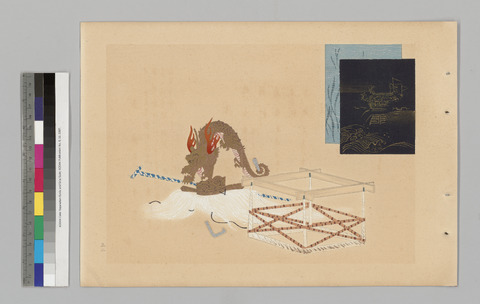
Play: Tamanoi (玉の井)
Print Date: 1924
Series: [List of Noh Play Equipment)] Nôgu Taikan (能具大鑑) #32
Image courtesy of the University of Pittsburgh
Note: Tsukurimono: Well marked by a square frame. Additionally, a
round frame stand supporting a
Japanese Judas tree is placed on the stage, but it is not depicted
on the print. Tsuribari (fishhook).
Kanmuri-mono: Crown with a white wig and a headdress of an old
dragon. Kasezue: Wooden cane
with a sideways grip on the top of the cane. Shikishi: Depicts
Ryûgû (Palace of the Dragon King).
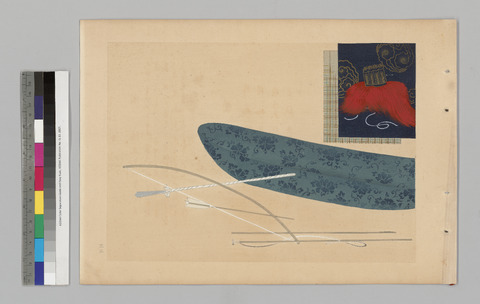
Play: Kuzu (国栖)
Print Date: 1924
Series: [List of Noh Play Equipment)] Nôgu Taikan (能具大鑑) #33
Image courtesy of the University of Pittsburgh
Note: Tsukurimono: Ôfune: Large boat. Mochimono: Tsurizao (fishing
rod) and sao (pole). Yari
(spear) and yumiya (bow and arrow): Kyôgen-kata use these props as
Shite's pursuers. Shikishi:
Depicts a crown for Nochi-shite and the kariginu's pattern.
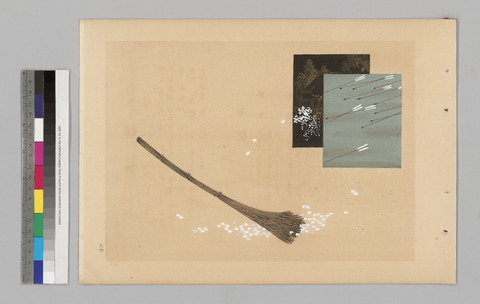
Play: Tamura (田村)
Print Date: 1924
Series: [List of Noh Play Equipment)] Nôgu Taikan (能具大鑑) #34
Image courtesy of the University of Pittsburgh
Note: Mochimono: Hagi-bōki (broom of Japanese bush clover). Also
called tama-bahaki (jeweled
broom). Fallen petals are arranged to make a scene of the
Shite sweeping the fallen petals under the
flowering trees. Shikishi: One thousand arrowheads, which is
mentioned in the play, and a drawing of
Springtime at Kiyomizu-dera temple.
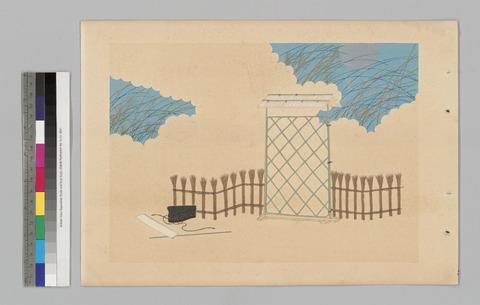
Play: Kogô (小督)
Print Date: 1924
Series: [List of Noh Play Equipment)] Nôgu Taikan (能具大鑑) #35
Image courtesy of the University of Pittsburgh
Note: Tsukurimono: Single swing door with hedges made by Japanese
bush clover. Mochimono:
Riding crop and a letter for Shite, Nakakuni. Kanmuri:
Kazaori-eboshi. Bright moon in the night sky
over Sagano is depicted on the background.
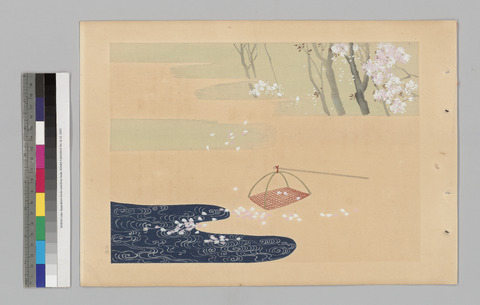
Play: Sakuragawa (桜川)
Print Date: 1924
Series: [List of Noh Play Equipment)] Nôgu Taikan (能具大鑑) #36
Image courtesy of the University of Pittsburgh
Note: Tsukurimono: Scooping net . It says in the play, " The
cherry blossoms are falling on the river.
It looks like white waves, but they are falling from above. Are
they cherry blossoms, or snow?"
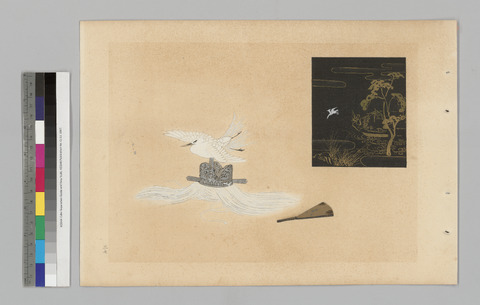
Play: Sagi (鷺)
Print Date: 1924
Series: [List of Noh Play Equipment)] Nôgu Taikan (能具大鑑) #37
Image courtesy of the University of Pittsburgh
Note: Kanmuri: Crown with a headdress of heron and Shirotare
(white wig). Mochimono: Chûkei with
golden tortoise design. Shikishi: Depicts a heron playing at
Shinsen-en Garden.
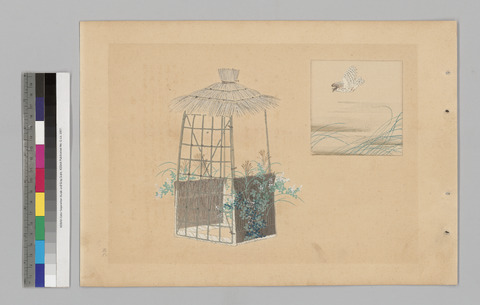
Play: Hibariyama (雲雀山)
Print Date: 1924
Series: [List of Noh Play Equipment)] Nôgu Taikan (能具大鑑) #38
Image courtesy of the University of Pittsburgh
Note: Old Kongô school style. Tsukurimono: Thatched hut with
flowers and leaves attached, as
shown on the print. Other schools use the tsukurimono used in
"Rôdaiko" and attach cedar leaves.
Shikishi: Depicts a falcon at Mt. Hibariyama because Taka-gari
(falconry) is performed during the
kyôgen.
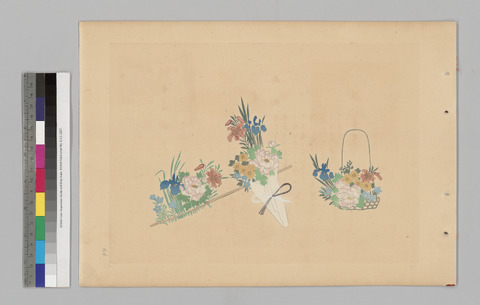
Play: Hibariyama (雲雀山)
Print Date: 1924
Series: [List of Noh Play Equipment)] Nôgu Taikan (能具大鑑) #39
Image courtesy of the University of Pittsburgh
Note: Three types of bouquets of flowers. Shite uses one of them,
according to his preference. Same
in all schools. In Kanze school, Shite usually uses the bunch of
flowers wrapped by noshi (gift wrapping
paper). Noshi-wrapped bouquet must be used when performing in
front of the royal family.
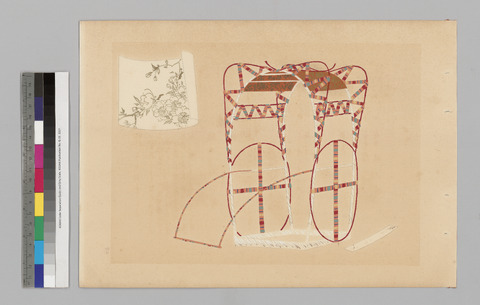
Play: Yuya (熊野)
Print Date: 1924
Series: [List of Noh Play Equipment)] Nôgu Taikan (能具大鑑) #40
Image courtesy of the University of Pittsburgh
Note: Tsukurimono: Carriage. This prop is also used in the plays
of "Oshio," "Zegai," and "Sumiyoshi-
môde." In "Zegai" and "Oshio," however, the carriage is wrapped in
dan-bôji (a strip of bluish cloth)
rather than red. Mochimono: A letter on the tanzaku (poem slip).
Shikishi: Depicts cherry blossoms in
Kiyomizu-dera temple, which Shite mentions in this play.
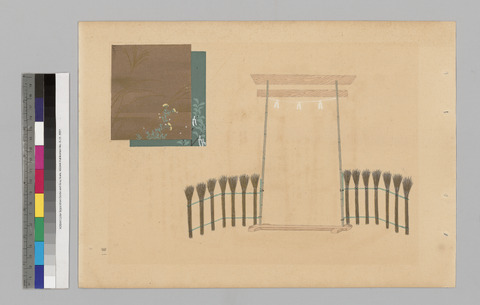
Play: Nonomiya (野宮)
Print Date: 1924
Series: [List of Noh Play Equipment)] Nôgu Taikan (能具大鑑) #41
Image courtesy of the University of Pittsburgh
Note: Tsukurimono: Torii gate and the brushwood fence, referred to
as "Kuroki no Torii." Shikishi:
Front shikishi depicts autumn grasses because it says in the play
"Lady Rokujô came to the shrine
by the ox-drawn carriage covered by autumn grasses and flowers."
Back shikishi depicts sakaki
(Cleyera japonica) because it says in the play "Hikaru Genji
brought sakaki when he visited the Lady
Rokujô at Nonomiya Shrine on the seventh day of the ninth month."
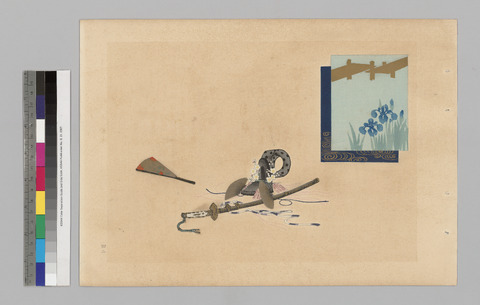
Play: Kakitsubata (杜若)
Print Date: 1924
Series: [List of Noh Play Equipment)] Nôgu Taikan (能具大鑑) #42
Image courtesy of the University of Pittsburgh
Note: Kanze school. Kanmuri: Ui-kanmuri with a rounded tail on the
back of the crown and oikake on
both sides. Oikake: Ornament made by horsetail hair in a fan
shape. Plums and peach-colored cords
will be attached to the crown as shown in the print when "Sawabe
no mai" kogaki is followed. Tachi:
ma-dachi (Japanese sword). Cyûkei (fan). Shikishi: Depicts
Yatsuhashi bridge in Mikawa province.
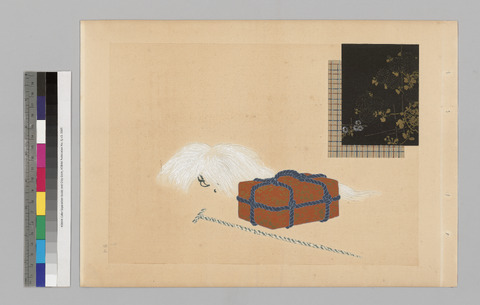
Play: Koi no Omoni (恋重荷)
Print Date: 1924
Series: [List of Noh Play Equipment)] Nôgu Taikan (能具大鑑) #43
Image courtesy of the University of Pittsburgh
Note: Tsukurimono: Omoni (heavy burden): Make a color as shown on
the print with red brocade and
tied it with a rope made by dark blue paper . Kasezue: A
wooden cane with a sideways grip on the top
of the cane. Kasezue in this play is wrapped in white bōji (a
strip of cloth) . Kashira: white wig for
Nochi-shite. Shikishi: Front shikishi depicts chrysanthemums since
Mae-shite is a master at growing
chrysanthemums. Back shikishi depicts small grid pattern of the
kitsuke (short-sleeved kimono).
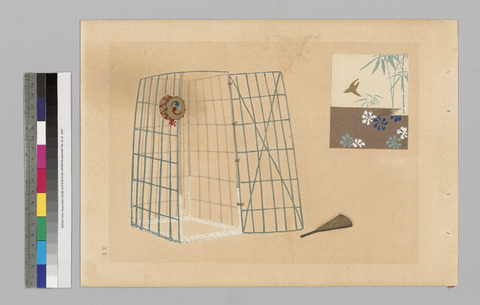
Play: Rôtaiko (籠太鼓)
Print Date: 1924
Series: [List of Noh Play Equipment)] Nôgu Taikan (能具大鑑) #44
Image courtesy of the University of Pittsburgh
Note: Tsukurimono: Jail: Tie up a drum. Mochimono: Chûkei without
designs. Shikishi:
Upper part of shikishi depicts a Japanese bush warbler and bamboo
because they are
mentioned in the play. Lower part of shikishi depicts the pattern
of Shite's kitsuke (short-
sleeved kimono).
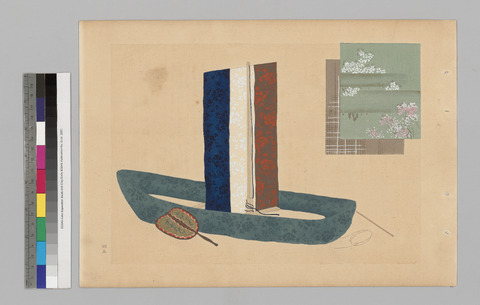
Play: Tôsen (唐船)
Print Date: 1924
Series: [List of Noh Play Equipment)] Nôgu Taikan (能具大鑑) #45
Image courtesy of the University of Pennsylvania
Note: Tsukurimono: Frame of a boat. Mochimono: Tô-sen (a round fan
held by a Chinese character),
muchi (stick) and te-nawa (hand rope). Shikishi: Depicts flowers
because it says in the play, "Graze
horses in Mt. Huashan and herd cows to the peach trees. This is a
famous place for flowers."
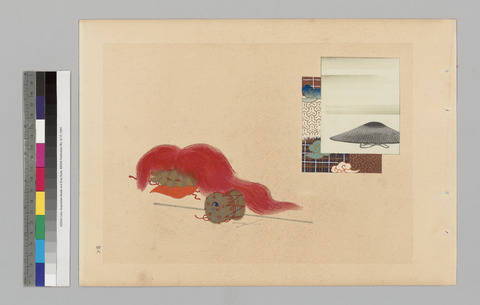
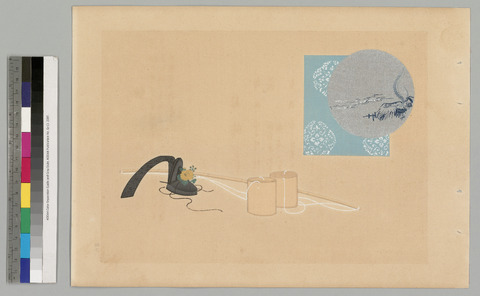
Play: Mochizuki (望)月
Print Date: 1924
Series: [List of Noh Play Equipment)] Nôgu Taikan (能具大鑑) #46
Image courtesy of the University of Pennsylvania
Note: Kongô school. Tsukurimono: Aka-gashira (red wig) for lion
dance. Put a golden fan on his wig
and cover his face with a red cloth. The face cover differs
depending on school. Mochimono: Kakko
(small drum) and sticks for Kokata, a child actor. In Kanze
school, Shite sometime uses a white wig.
In old style, a peony was putted in the wig. Shikishi: Front
shikishi depicts otoko gasa (men's sedge
hat). Back shikishi depicts the atsuita pattern on the kimono worn
by Shite in a tsubo-ori style.
Play: Tôru (融)
Print Date: 1924
Series: [List of Noh Play Equipment)] Nôgu Taikan (能具大鑑) #47
Image courtesy of the University of Pittsburgh
Note: Kongô school. Mochimono: Two tago-oke (buckets) and a bamboo
pole to collect and carry
brine. Kanmuri: Ui-kanmuri. Put a yellow chrysanthemum on the top
as shown in the print when
"Shaku no mai" kogaki is followed. Upper right circle depicts the
moon and a beach. It says in the
play, "The moon has already risen in the sky. In the evening when
tides go full, the beach of
Shiogama here looks lonely." Shikishi: Depicts the pattern of
wisteria on sashinuki (a type of
hakama) for Nochi-shite.
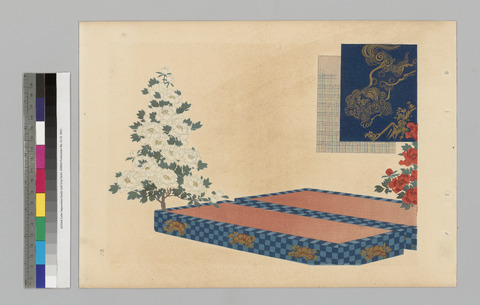
Play: Shakkyô (石橋)
Print Date: 1924
Series: [List of Noh Play Equipment)] Nôgu Taikan (能具大鑑) #48
Image courtesy of the University of Pittsburgh
Note: Kongô school. Tsukurimono: Ichijôdai. Two Ichijôdai are used
when performing Renjishi (dance of
two Lions). Kongô School adds golden peony on a pattern of
ichimatsu around the Ichijôdai. White and
red peony threes are on each ichijôdai. Shikishi: Depicts a lion
and the pattern of small grid seen on
kitsuke (short-sleeved kimono). Tsukurimono are identical, but the
pattern of around the Ichijôdai differ
based on school.
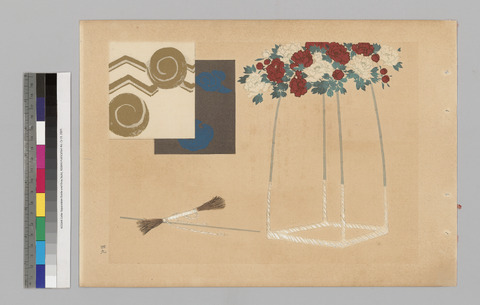
Play: Shakkyô (石橋)
Print Date: 1924
Series: [List of Noh Play Equipment)] Nôgu Taikan (能具大鑑) #49
Image courtesy of the University of Pittsburgh
Note: Kanze school. Tsukurimono: Frame is set in front of the
hayashigata (instrumental performers)
when Kanze school kogaki "Jyūnidan" is performed. Kanze school
also uses the Ichijōdai shown in
Shakkyô 1. Mochimono: Hagishiba (bunch of hagi). Use differs
depending on school. Taketsue
(bamboo stick). Shikishi: Depicts patterns of hangiri (a type of
hakama) and happi (a long-sleeved
garment) which are based on a rule of Kanze school.
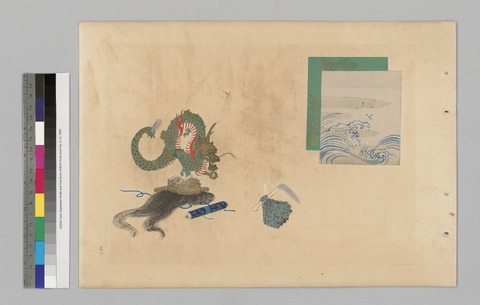
Play: Ama (海士)
Print Date: 1924
Series: [List of Noh Play Equipment)] Nôgu Taikan (能具大鑑) #50
Image courtesy of the University of Pittsburgh
Note: Mochimono: Miru (a type of seaweed) and a hook are for
Mae-shite. Miru is made of cedar
leaves. Handscroll for Nochi-shite. Kashira: Kurotare (black wig)
with the headdress of a dragon.
Kanze school uses a sea dragon. Shikishi: Depicts the world
beneath the sea.
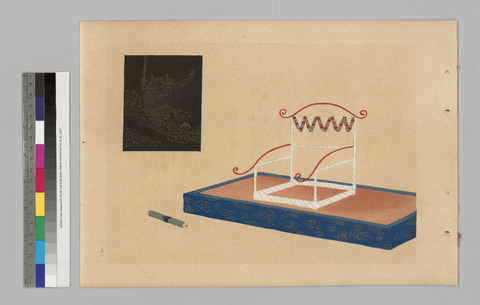
Play: Daie (大會)
Print Date: 1924
Series: [List of Noh Play Equipment)] Nôgu Taikan (能具大鑑) #51
Image courtesy of the University of Pittsburgh
Note: Kongô school. Tsukurimono: Wheeled chair and an Ichijôdai.
Mochimono: Handscroll. Shikishi:
Depicts Taishakuten, one of the guardian gods of the Buddhism. It
says in the play, "Mt. Hieizan
suddenly thundered out and shook, then Taishakuten came from the
sky."
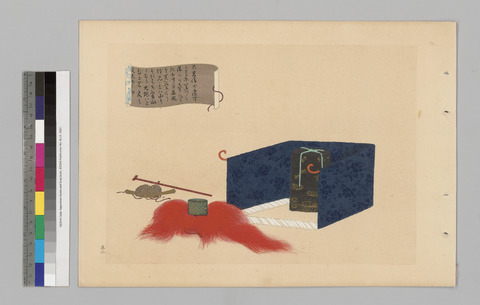
Play: Daie (大會)
Print Date: 1924
Series: [List of Noh Play Equipment)] Nôgu Taikan (能具大鑑) #52
Image courtesy of the University of Pittsburgh
Note: Kanze school. Tsukurimono: Chair, which will be set on an
Ichijôdai as in Daie 1.
Daizukin: Aka-gasira (red wig) for Nochi-shite. Tengan: Crown for
Taishakuten. There is
no headdress. Uchizue: Thin stick, about 60 cm long, with cross
bar at the end. An opened
handscroll is depicted at the upper left.