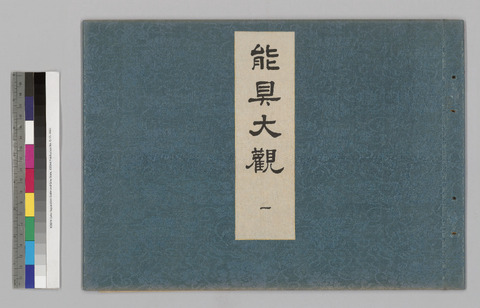
Series Cover, Vol. 1
Date: 1924
Series: [List of Noh Play Equipment)] Nôgu Taikan (能具大鑑)
Image courtesy of the University of Pittsburgh
YAMAGUCHI RYÔSHÛ
(山口蓼洲)
1924 (Nôgu Taikan
Vol. 1)
Series Cover, Vol. 1
Date: 1924
Series: [List of Noh Play Equipment)] Nôgu Taikan (能具大鑑)
Image courtesy of the University of Pittsburgh
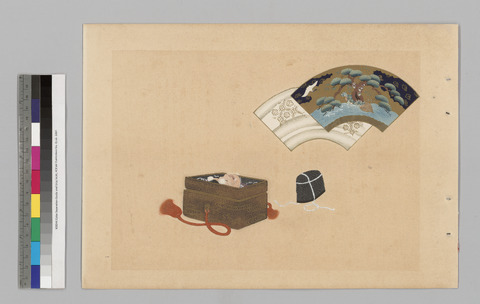
Play: Okina (翁)
Print Date: 1924
Series: [List of Noh Play Equipment)] Nôgu Taikan (能具大鑑) #1
Image courtesy of the University of Pittsburgh
Note: Kanze school. Menbako (mask box): Box containing a mask and
a bell for Sanbasô.
Okina-eboshi: The strings for this eboshi are called Kanze-yori,
which is twisted in the Kanze style.
Senmen (surface of the fan): Depicts the design on the chûkei held
by Okina and the Kensoku
Shokkoukin pattern on the kariginu.
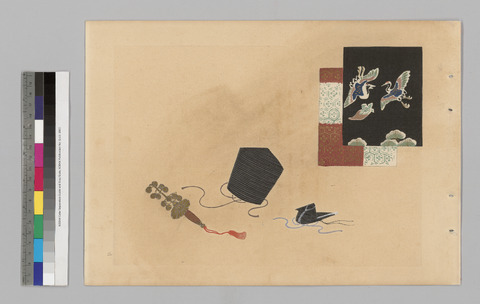
Play: Sanbasô (三番叟)
Print Date: 1924
Series: [List of Noh Play Equipment)] Nôgu Taikan (能具大鑑) #2
Image courtesy of the University of Pittsburgh
Note: Kensaki-eboshi. Samurai-eboshi: Worn before Senzai and
Sanbasô. Suzu (bell): Sanbasô
uses this bell. Shikishi: Depicts the patterns on kitsuke
(short-sleeved kimono) on the suô-style
kimono for Sanbasô.
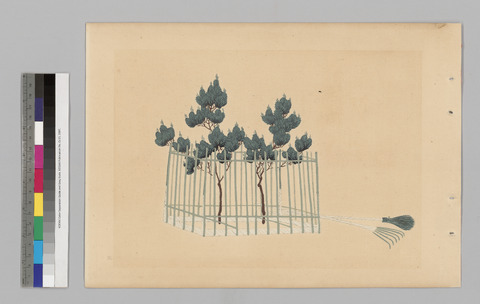
Play: Takasago (高砂)
Print Date: 1924
Series: [List of Noh Play Equipment)] Nôgu Taikan (能具大鑑) #3
Image courtesy of the University of Pittsburgh
Note: Tsukurimono: Each school uses this tsukurimono in
Takasago. Mochimono: Sarae (rake) for
Mae-shite, sugi-hōki (broom of cedar) for Tsure.
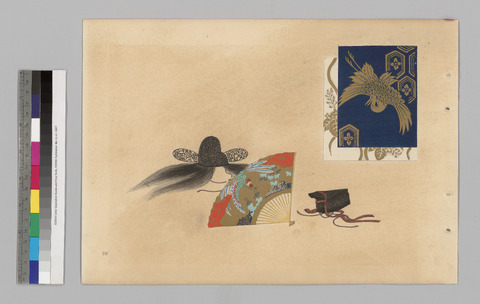
Play: Takasago (高砂)
Print Date: 1924
Series: [List of Noh Play Equipment)] Nôgu Taikan (能具大鑑) #4
Image courtesy of the University of Pittsburgh
Note: Shikishi: The pattern of kariginu (A long-sleeved garment)
and Hangiri (abbreviation for
hangiribakama, divided skirts), which are used in Kanze school.
Kami-ōgi (god fan), suki-kanmuri,
and kuro-tare (black wig) for Nochi-shite. Daijin-eboshi for Waki.
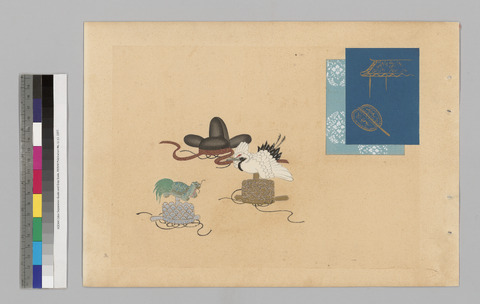
Play: Tsurukame (鶴亀)
Print Date: 1924
Series: [List of Noh Play Equipment)] Nôgu Taikan (能具大鑑) #5
Image courtesy of the University of Pittsburgh
Note: Tsukurimono: Rissya daikyûden: Palace on platform.
Mochimono: Tô-uchiwa for Shite. These
two are not depicted in the print but are shown on the front
shikishi, which is in the upper right corner.
Kanmuri-mono: Tôkanmuri (black crown for demon god) with red and
gold brocade headband.
Tsuru-kanmuri: Crown with headdress of crane worn by Kokata.
Kame-kanmuri: Crown with headdress
of tortoise worn by Kokata. Shikishi: Back shikishi depicts
Sashinuki pattern for Shite.
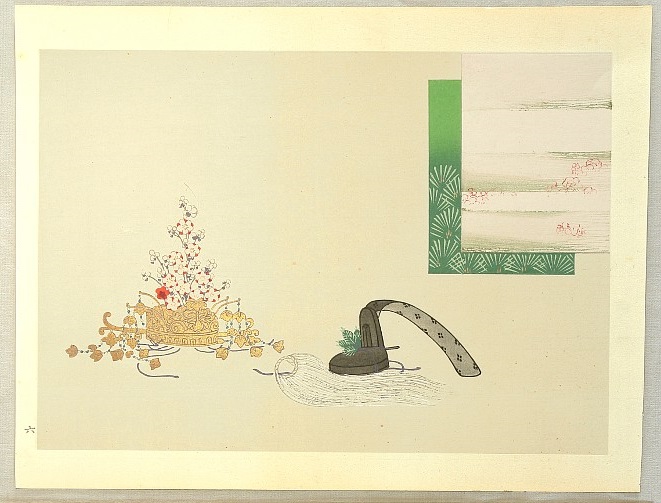
Play: Oimatsu (老松)
Print Date: 1924
Series: [List of Noh Play Equipment)] Nôgu Taikan (能具大鑑) #6
Image courtesy of Artelino.com
Note: Mochimono: Sugi-houki (broom of cedar) for Mae-shite. This
is not depicted on the print.
Kanmuri-mono: Ui-kamuri with pine trees and shiro-tare (white wig)
for Nochi-shite. Tsure
Kanmuri-mono: Tengan with a plum from Kōbaiden (Plum Palace).
Shikishi: Kōbaiden (Plum
Palace) and Oimatsuden (Pine Palace).
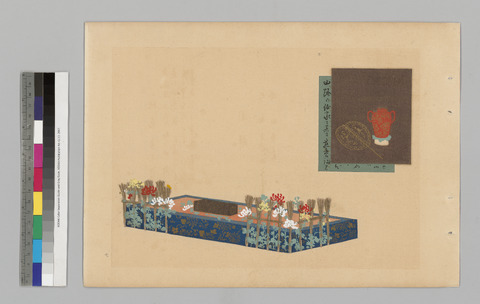
Play: Makura Jidô (枕慈童)
Print Date: 1924
Series: [List of Noh Play Equipment)] Nôgu Taikan (能具大鑑) #7
Image courtesy of the University of Pittsburgh
Note: Tsukurimono: Platform for growing chrysanthemums.
Mochimono: Yakuko (medicine pot), which is depicted in the
shikishi.
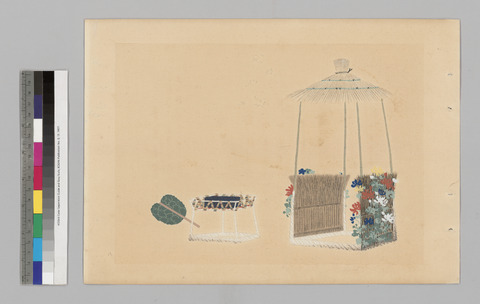
Play: Kiku Jidô 菊慈童
Print Date: 1924
Series: [List of Noh Play Equipment)] Nôgu Taikan (能具大鑑) #8
Image courtesy of the University of Pittsburgh
Note: Tsukurimono: Thatched hut. Mochimono: Ha-uchiwa (round fan
made of leaves). Only used in
Kanze school. Makuradai (headrest): Used in antiquity instead of
ichijôdai.
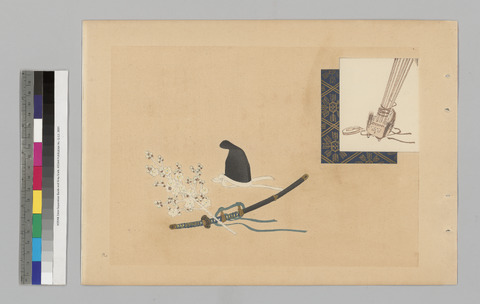
Play: Ebira (箙)
Print Date: 1924
Series: [List of Noh Play Equipment)] Nôgu Taikan (能具大鑑) #9
Image courtesy of the University of Pittsburgh
Note: Kazaori-eboshi with a white head band. Tachi (sword).
Tsukurimono: Plum flowers. Shikishi:
Yaguruma (arrow wheel on the blue shikishi) is the pattern of
Happi (a broad-sleeved garment) worn
by Shite.
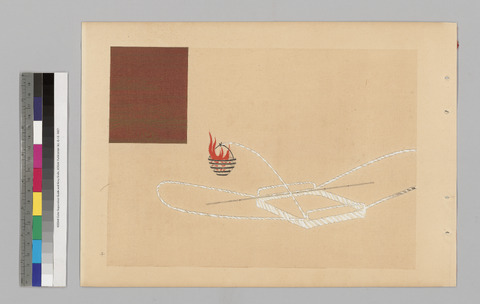
Play: Michimori (通盛)
Print Date: 1924
Series: [List of Noh Play Equipment)] Nôgu Taikan (能具大鑑) #10
Image courtesy of the University of Pittsburgh
Note: Tsukurimono: Boat and balefire. Mochimono: Sao (pole).
Shikishi: Whirlpool.
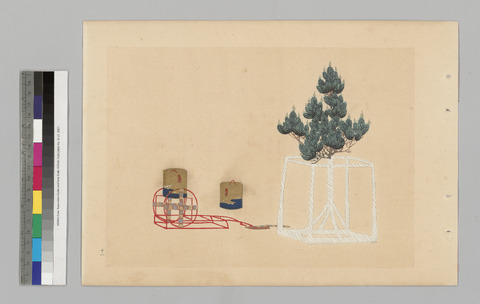
Play: Matsukaze (松風)
Print Date: 1924
Series: [List of Noh Play Equipment)] Nôgu Taikan (能具大鑑) #11
Image courtesy of the University of Pittsburgh
Note: Hōshō school. Tsukurimono: Square frame as shown in the
print.
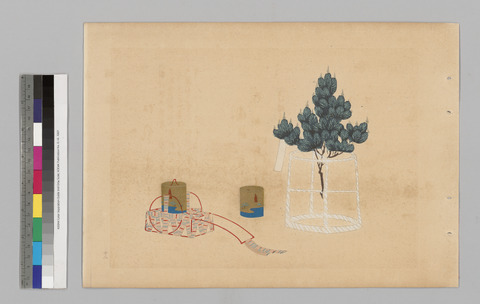
Play: Matsukaze (松風)
Print Date: 1924
Series: [List of Noh Play Equipment)] Nôgu Taikan (能具大鑑) #12
Image courtesy of the University of Pittsburgh
Note: Kanze school. Tsukurimono: Attach a strip of paper to the
pine as shown in the print when
there "Matsugi no kyoku" kogaki (variant) is used. Shiokumi
guruma: Cart with buckets of salt brine.
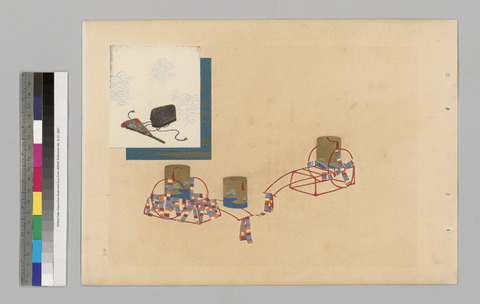
Play: Matsukaze (松風)
Print Date: 1924
Series: [List of Noh Play Equipment)] Nôgu Taikan (能具大鑑) #13
Image courtesy of the University of Pittsburgh
Note: Tsukurimono: Kita school and Kongô school use same style of
pine tree (not depicted in the
print). Shiokumi guruma: Cart with buckets of salt brine. Right
cart is Komparu school. Left cart is
Kongô school. Shikishi: Waves of Suma Bay.
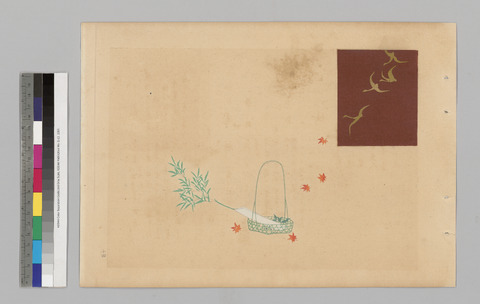
Play: Hanagatami (花筐)
Print Date: 1924
Series: [List of Noh Play Equipment)] Nôgu Taikan (能具大鑑) #14
Image courtesy of the University of Pittsburgh
Note: Kanze school. Mochimono: Put the bamboo grass wrapped in a
letter in the basket. Shikishi:
It says in the play, "The flying geese reflected on the rice
fields are a sign that guides me to the capital."
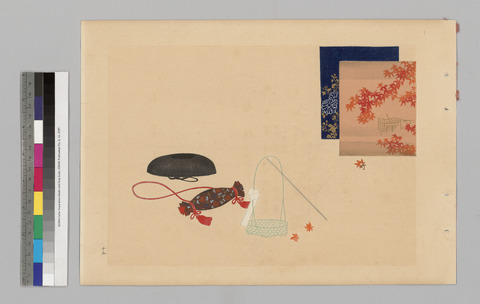
Play: Hanagatami (花筐)
Print Date: 1924
Series: [List of Noh Play Equipment)] Nôgu Taikan (能具大鑑) #15
Image courtesy of the University of Pittsburgh
Note: Kongō school. Mochimono: Basket with a letter tied to it.
Use the mamori bukuro as shown in
the print when "Katami no den" kogaki (variant) is used. Shikishi:
It says in the play, "It is September
now, still early for the season of drizzling rain. Although the
color of leaves is still pale, we have cleared
the path on which the emperor will travel."
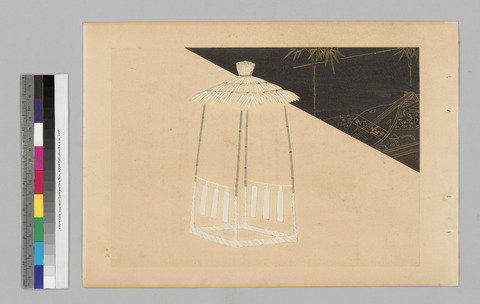
Play: Sekidera Komachi (関寺小町)
Print Date: 1924
Series: [List of Noh Play Equipment)] Nôgu Taikan (能具大鑑) #16
Image courtesy of the University of Pittsburgh
Note: Kongô school. Tsukurimono: Hut of Komachi. White strips of
paper attached to south end of
the hut. The strips are attached differently depending on the
school. Gold writing on dark blue at the
upper part indicates that the play is set during the Tanabata
festival.
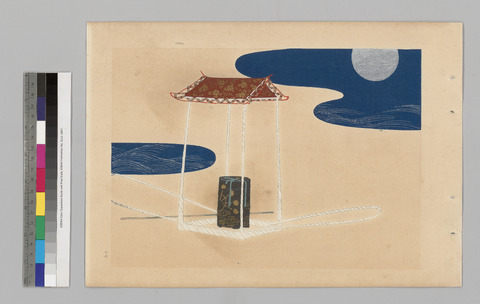
Play: Eguchi (江口)
Print Date: 1924
Series: [List of Noh Play Equipment)] Nôgu Taikan (能具大鑑) #17
Image courtesy of the University of Pittsburgh
Note: Kongō school. All schools except the Kanze school use props
depicted on the print.
Tsukurimono: Boat and pole. Kazura-oke (cylindrical lacquered
container): Placed in boat.
Background depicts water and moon. It says in the play, "On the
surface of the river, that reflects
the clear moon, a courtesan sings a song on a boat." Kanze school
does not use the kazura-oke.
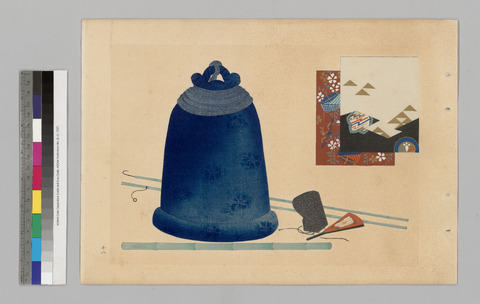
Play: Dôjôji (道成寺)
Print Date: 1924
Series: [List of Noh Play Equipment)] Nôgu Taikan (能具大鑑) #18
Image courtesy of the University of Pittsburgh
Note: Kanze school. Tsukurimono: Kane (bell): made of brocade with
a peony pattern. Bamboo:
Thick bamboo stalk is used for carrying the bell to the stage by
Kyōgen-gata. Thinner bamboo stalks
are used for lifting the bell. Eboshi. However, the sui-kanmuri
with the pattern of blue plum is used
when the "Akagashira" kogaki (variant) is used. Ōgi: Fan with
single peony pattern. When the head of
Kanze school plays Shite, he uses the fan with hana no maru
instead. Shikishi: Front shikishi depicts
Karaori, the pattern of the costume for Shite. Back shikishi
depicts koshimaki pattern.
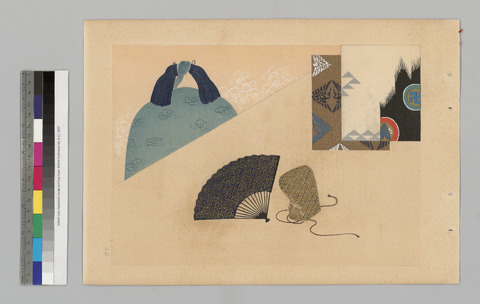
Play: Dôjôji (道成寺)
Print Date: 1924
Series: [List of Noh Play Equipment)] Nôgu Taikan (能具大鑑) #19
Image courtesy of the University of Pittsburgh
Note: Kongô school. Kane (bell): Pattern of Kongô cloud on the
Moegi Donsu (yellow-green brocade).
Kanmuri: Kin-kanmuri (gold crown). Use kuro-kanmuri (black crown)
when use aka-gashira (red wig).
Reverse of Kanze school. Ôgi: Ôuchi-bishi pattern. Kongô school
only. Shikishi: Front shikishi depicts
koshimaki pattern. Back shikishi depicts tsurubishi (crane in
diamond shape), the pattern of the
costume for Shite.
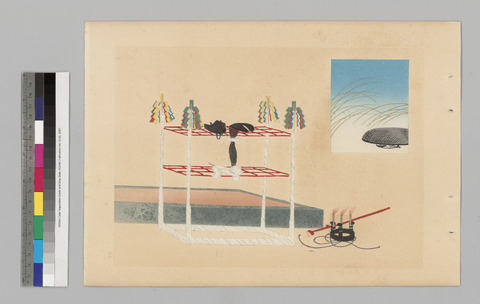
Play: Kanawa (鉄輪)
Print Date: 1924
Series: [List of Noh Play Equipment)] Nôgu Taikan (能具大鑑) #20
Image courtesy of the University of Pittsburgh
Note: Tsukurimono: Ichijô-dai, five-colored nusa (strips of cut
paper), white nusa, samurai-eboshi
and mage (top-knotted wig). Mochimono: Kanawa (iron trivet) and
uchizue (stick with a cross bar at
the end) for Nochi-shite. Shikishi: Depicts Ichihara-field and
onna gasa (woman's cap) for Mae-shite.
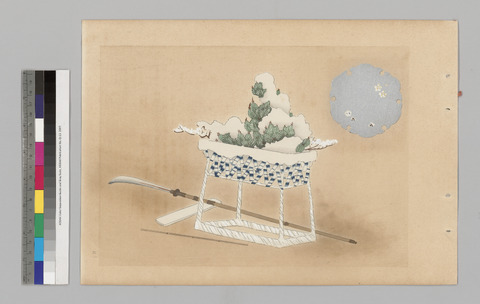
Play: Hachinoki (鉢木)
Print Date: 1924
Series: [List of Noh Play Equipment)] Nôgu Taikan (能具大鑑) #21
Image courtesy of the University of Pittsburgh
Note: Kongō school. Tsukurimono: Pine tree covered with snow.
Taller than the pine tree used by
Kanze school. Mochimono: Naginata (curved-blade pole weapon) for
Nochi-shite, Jōba-muchi
(riding crop) and Juryōjō (letter of acceptance). Upper right
circle depicts Yuki oke (snow bucket).
Plum and cherry blossoms, as described in play.
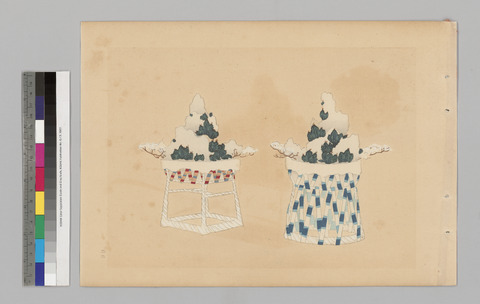
Play: Hachinoki (鉢木)
Print Date: 1924
Series: [List of Noh Play Equipment)] Nôgu Taikan (能具大鑑) #22
Image courtesy of the University of Pittsburgh
Note: Tsukurimono: Right frame is for Kanze school. Left frame is
for Hôshô school.
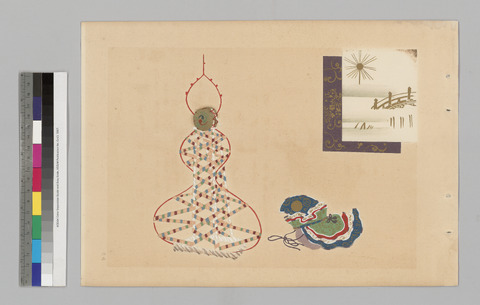
Play: Fuji Daiko (富士太鼓)
Print Date: 1924
Series: [List of Noh Play Equipment)] Nôgu Taikan (能具大鑑) #23
Image courtesy of the University of Pittsburgh
Note: Tsukurimono: Taiko (drum) and torikabuto (a bird-shaped
hat). Note: These tukurimono are
also used in Tenko and Umegae. Shikishi: Front shikishi depicts
Sumiyoshi, home of Shite. Back
shikishi depicts maiginu (wide-sleeve kimono for dancing) pattern,
worn after Shite changes costume
on stage.
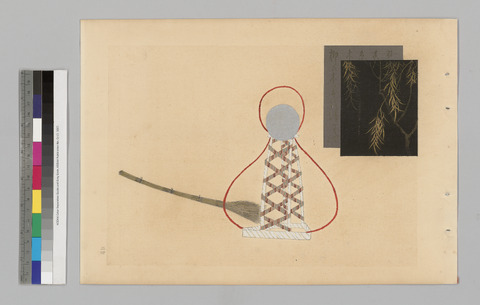
Play: Shôkun (昭君)
Print Date: 1924
Series: [List of Noh Play Equipment)] Nôgu Taikan (能具大鑑) #24
Image courtesy of the University of Pittsburgh
Note: Tsukurimono: Kagami dai (mirror stand). Shape of the mirror
stand based on Kongô school.
Hagi-bôki (broom of Japanese bush clover) for Mae-shite. Note:
These tsukurimono are also used in
the plays of "Matsuyama-kagami" and "Kôtei." Shikishi: Depicts
withered leaves of willow based on
the play. It says, "spring is coming but leaves of willow are..."
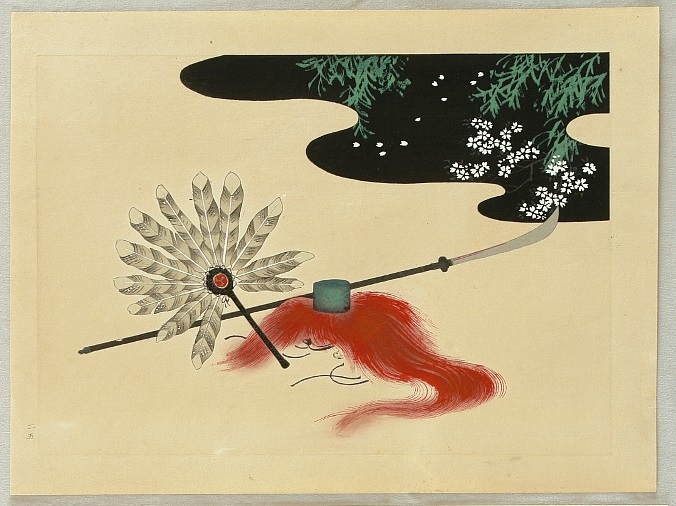
Play: Kurama Tengu (鞍馬天狗)
Print Date: 1924
Series: [List of Noh Play Equipment)] Nôgu Taikan (能具大鑑) #25
Image courtesy of Artelino.com
Note: Mochimono: Akazu dai-zukin (a hood with the red wig) and fan
for Nochi-shite, the
Kurama-tengu (goblin). Naginata (curved-blade pole weapon): For
kokata, Ushiwakamaru.
Kumotorigata: Uzu-zakura (cherry blossoms) at Mt. Kurama depicted
in the shape of a black cloud
on the top right.
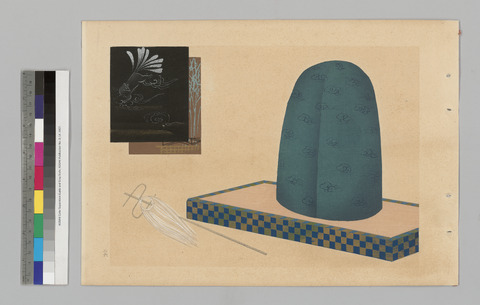
Play: Sesshōseki (殺生石)
Print Date: 1924
Series: [List of Noh Play Equipment)] Nôgu Taikan (能具大鑑) #26
Image courtesy of the University of Pittsburgh
Note: Tsukurimono: Ichijō-dai (one-tatami platform). Prop on the
ichijō-dai is Sesshôseki (Killing
Stone); it is designed to crack in the middle. Hashigo (ladder):
Kyōgen-gata uses the prop during
his Aigatari (entr'acte monologue) Shikishi: Front shikishi
depicts Tamamo-no-mae, the nine
tailed fox spirit trapped in the killing stone. Back shikishi
depicts the Seiryô-den palace where
Tamamo-no-mae was loved by the emperor.
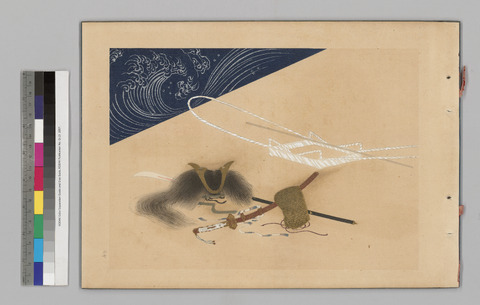
Play: Funa Benkei (船弁慶)
Print Date: 1924
Series: [List of Noh Play Equipment)] Nôgu Taikan (能具大鑑) #27
Image courtesy of the University of Pittsburgh
Note: Kanze school. Tsukurimono: Boat and pole. Kin-eboshi:
Mae-shite Shizuka uses for her dance.
Kuwagata Kurogashira: Black wig with a hoe-shaped helmet crest.
Nochi-shite Taira no Tomonori
wears it. Tachi (Japanese sword): Tachi illustrated in the print
is used only when "Shiranami no den"
kogaki (variant) is followed. Ordinary tachi is used for other
cases. Naginata (curved-blade pole
weapon): Used by Nochi-shite.